Stonehenge

Stonehenge
Showing posts with label British Museum. Show all posts

Saturday, March 1, 2014

London Revisited


Children playing in a park near St. Pancras Station, London
 
5/22/10
Sitting in a pastry shop in St. Pancras terminal, strategizing my stay here in London (~ 2 days). I got 50 Pounds (L) out of the cash machine and intend to go to the Ruskin Hotel to see if they have a room for a night or two. I dropped off all my bags (except for the back-pack purse) at bag storage. After checking out the Ruskin hotel, I intend to come back to St. Pancras and take the underground to the airport and time that trip in order to decide whether to stay one night or two in this area or near the airport.
There are two men sitting next to me speaking something that seems like a cross between Italian, French and Spanish. Could it be Basque?
Herds of travelers pass by – East Indian, Oriental, American. Now it has thinned out to just a few. The contemporary female fashion seems to be a very short skirt dress (shirtwaist-like, although frilly and gauzy), just covering the butt-cheeks, with (and sometimes without) leg-clinging tights. A Buddhist monk, alone, just walked by in a saffron robe.

5/24/10
I am at Heathrow Airport – an hour earlier than the two hours early I was supposed to arrive – sitting in an Italian coffee shop sipping cappuccino. My alarm clock was set on French time, so I awoke an hour earlier than I needed to, but I didn’t realize it until nearly dressed. Getting here – to the right place at the right time – from the end of the organ tour in Toulouse, France, was not a trivial effort. In the first place, I could not make train reservations through to London on Friday, as I had hoped to, so I went to Paris on Friday and then on to London early Saturday morning. The train tickets through to London cost an additional 200.00 Euros beyond the Eurail discount, but I did catch the TGV to Paris and the Eurostar (chunnel train) to London.
In Paris, I took the Metro from Gare Parnasse to Gar du Nord and stayed at the Hotel Mercure, right across from the train station so I would be near the station because the train departed at 7:13 am. As it was, I didn’t have a lot of extra time, because I didn’t know exactly where to go to catch the train, and we had to do a double pass & security check – one to get out of France, and the other to get into England. But I made it.
Then, in London (Pancras Station), I needed to find a place to stay. I checked all my bags (including the food bag) at baggage storage, had a pastry and coffee, and then took the underground to Russell Square and walked to the Ruskin Hotel. They were all booked, but the man at the desk remembered me from before and said I could have a downstairs room (“needing renovation’) if I was only staying one night. So, I took the room, went to the British Museum again for a while and saw some things I hadn’t seen before, including the Korean room, and the large collection of exquisite Chinese ceramics, as well as a special exhibit on Chinese jade, and an “eye-opener” tour (again by Margaret Friday) on art in the Middle East. Then I had “lunch,” i.e., a large hot dog with lots of onions from a street vendor.
Afterwards, I took the Piccadilly line from Russell Square out to Heathrow to see how long that would take (about an hour). So I decided I needed to get a place to stay near the airport and, after much walking about and asking questions (the hotel accommodations people at Heathrow are singularly unhelpful), I caught a “hotel-hoppa” bus to the Holiday Inn and managed to get a room there. They had no single, non-smoking rooms, so I settled for a “smoking” room. I went back to the airport (this time by a free bus) and from there via underground to St. Pancras station, where I picked up my carry-on and the food bag, bought some food at a grocery store in the station, and took them all back to the Ruskin Hotel.
Pericles, British Museum
 
I spent that night sniffing, coughing and wheezing with what turned out was the beginning of a nasty cold (coughed up black specs, as well – volcanic ash, perhaps?). The next day, after a morning online at the Korean coffee shop near the museum, and another visit to the British Museum (early Greek period), I schlepped all my stuff by Metro to the Holiday Inn by the airport. From there I will fly to Kiev.
 

Saturday, May 19, 2012

The Middle East in the British Museum

A very interesting and informative mini-lecture at the British Museum was on the history of the Middle East. The docent was a woman whom I had seen in that same gallery the evening of my first day in the museum, apparently giving a private tour to an American woman.  It turns out that the American woman was an old classmate who was in London briefly and wanted to see the Renaissance drawings on exhibit but couldn’t get in, and so she opted for the Mesopotamian galleries as a consolation prize.
Sacred Mesopotamian Ark

The guide was very knowledgeable and quite thorough.  She answered questions and went past her allotted time. She stayed and talked with me afterwards and gave advice on how to sequence the several galleries for optimal information.  She had puffy, blinking eyes and the air of one who likes her booze, but was competent and eager to do well and to accommodate those she was assisting.  I learned a lot. 
Assyrian god

I believe I have finally got straight the sequence of the great empires in the Middle East during the first millennium BCE.  The first empire was the Assyrian, followed by the Babylonian--actually, “Neo-Babylonian,” since the first Babylon was simply a city-state, conquered by the Assyrians in the seventh century BCE. Babylon, the city, later threw off the Assyrian shackles and formed its own empire by conquest.  The Persians from the north-east (Aryans, not Semites) then conquered the Babylonians and extended the Persian Empire from India to Greece.  This must have been around the time the Indo-Aryans also penetrated the Indian sub-continent.
Bringing tribute to a Persian ruler

The Persians were then conquered by the Greeks about 330 BCE under Alexander the Great, which “Greek Empire” disintegrated almost immediately upon Alexander’s death. But the Hellenization persisted and was appropriated by the Romans as they conquered many former Greek territories during the first centuries BCE and CE, particularly in the Near East and Egypt, as well as much of the territory surrounding the Mediterranean Sea west of Italy.
Alexander the Great

The guide focused on trade and the development of writing as key forces undergirding the formation of empires.  The writing and numbers essential for trade began with tokens in little clay bolles, followed by clay tablets with numbers inscribed on them ( a chevron was 10, and a filled-in circle was 60).  This let to pictograms and then to the alphabet, first developed by Phoenician traders.  Trade, numbers, and writing developed pari-passu.
The last talk I went to was one on money, my third afternoon in the museum.  Again, like writing, money developed from the needs of trade and communication between cultures.  Apparently, the Lydians were the first to use metallic coins (they had a lot of mineable electrum – a gold-silver alloy).  The Chinese, who invented paper, were the first to use paper money, when the coins (“cash”) became too heavy to carry in large quantities.
The train is getting close to Berlin now, but we’re still passing through fields of green and brown. White birds glided over a recently plowed field (near Hanover), looking for what?  Seeds? Unearthed invertebrates for food? Maybe both.  Another field, nearer Berlin, was populated with hundreds of huge, three-bladed windmills flapping lazily and effortlessly, generating electricity for the nearby countryside and beyond.

Monday, May 14, 2012

Trainride Reflections on the British Museum


On the train to Berlin, my mind wanders back to the British Museum.  During the days spent there, I took several of the Augenblick tours (what were they called?) – 20 to 40 minute mini-tours with commentary. These were overviews of a particular topic, illustrated by selected artifacts in the collection.  The first was about the Gods and Goddesses of Roman Britain, very interesting.  Julius Caesar was the first of the Roman generals to land on the island of Britain (a little before 50 BCE),  and he apparently set up a camp/trading colony there.  Hadrian was the emperor/general who actually conquered Britain more than a century and a half later, but Roman coins and other artifacts were deposited (or left around) in the interim and later found by archeologists.  The two main gods of the time and place were Mars (not surprising, since most of the Romans garrisoned there were military men) and Minerva, who apparently shared many attributes with a Celtic goddess (Morrigan) with whom she became conflated.  Christian symbols (Constantine’s cross) began to show up in the 4th century. 
The second mini-tour I took at the British Museum was in the Enlightenment Gallery, a very long hall with shelves and cabinets on both sides, and display cases in the central area.  This contains much of the earliest, original collection of the museum, donated by wealthy benefactors (including George III) from personal collections of curiosities and treasures brought back to England after world explorations during the 18th and 19th centuries.  Viewing this eclectic plethora of mostly human artifacts, all collected together in one spot, seemed at once unifying (harmonious) and improbably diverse (dissonant).  Human attempts to understand and to produce esthetic treasures that have significance and that will endure defy any explanation that might be culturally comprehensive.  The mini-lecture was done by a woman (they were all volunteers and mostly women) who was originally East Indian, I believe.  She tried to focus on women’s contribution to the Enlightenment, including the story of Mary Anning, who excavated fossils near her home by the sea and sold them to collectors.  She apparently found the first ichthyosaurus fossil and sold it to the British Mseum (through an intermediary?).  According to our guide, she was the original subject of the “she sells seashells by the seashore” tongue-twister that all English-speaking children learn when they are young.
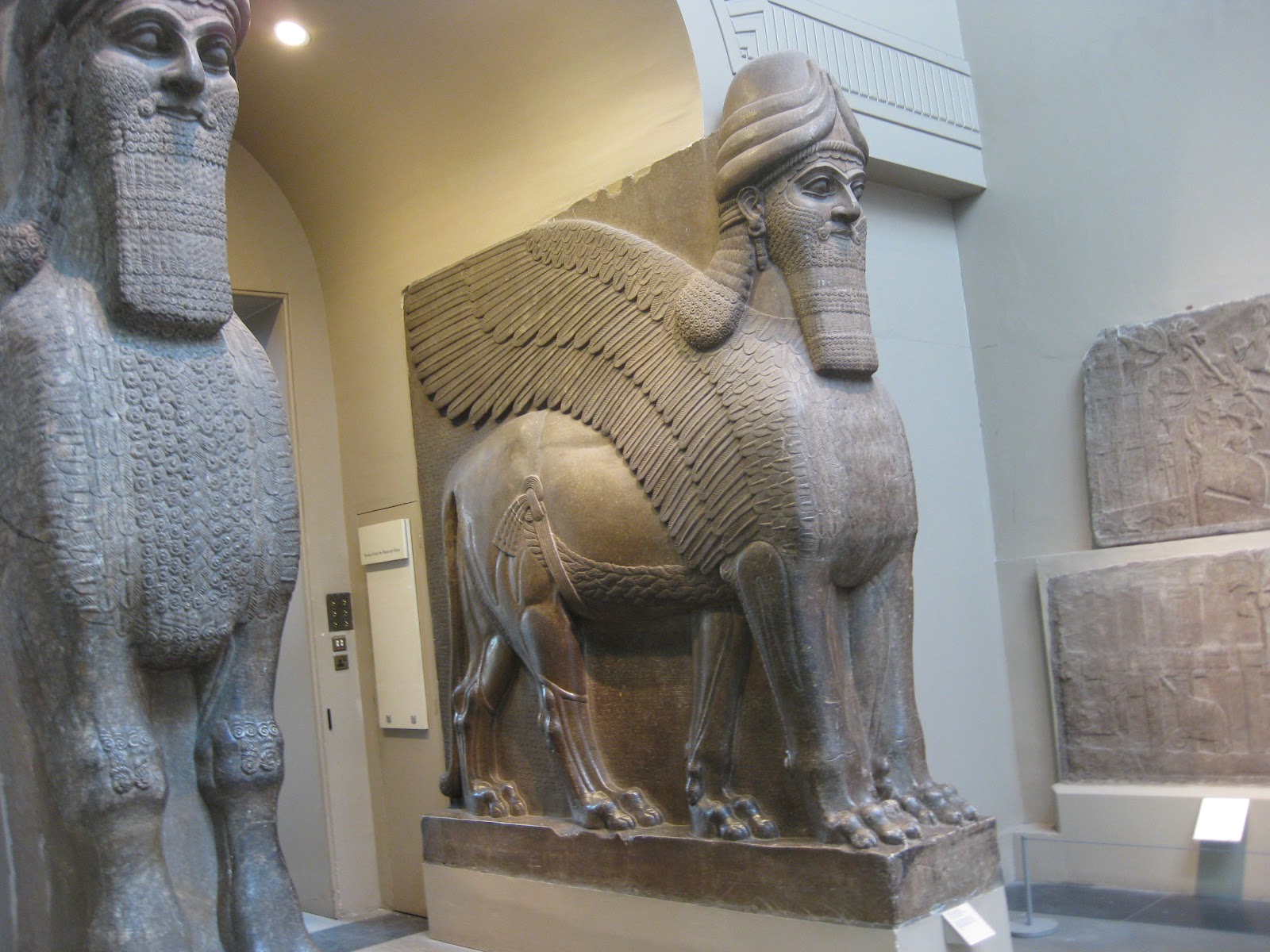
Another talk I attended was on the Assyrian friezes, a marvelous collection lining a couple of long hallways on the first floor of the museum flanked by beasts with human heads.  I had already walked through one of them (Ashurnasirpal’s) and read all the commentary, but I learned a lot from the mini-lecture, including the idea that wings on a form indicated a spiritual protector.  This is obviously where our ideas of angels come from.  I learned that Shamash, the sun god, was a disc with wings (a symbol that shows up with Apllo, also, I believe). Astarte was the planet Venus (symbol = star/flower), and Sin was god of the moon, symbolized by the crescent.  So the Muslims worship the moon, also, although they probably don’t realize it. In the friezes, one can identify kings by their “horned” hats (helmets, crowns) and eunuchs by their lack of beards.

Thursday, March 22, 2012

London

4/24/10 – Saturday

This morning, as I look out the second story window of the little Ruskin Hotel onto Montague Street below, most people are sauntering easily in groups of two or three, going in either direction along the sunny sidewalk in front of the high, spear-pointed iron gratings of the fence surrounding the British Museum. This ambulatory pattern is quitge unlike yesterday or the day before, both workdays, when people passed quickly and with a determined gait, usually walking alone in the direction of a bus stop for downtown London.
The stay in London has been marvelous; it could hardly have been better.  The weather was warm but not hot, the sun shone almost every day, all day long. Though I was inside the Museum most of the time, the sun shining through tinted glass into the covered courtyard was marvelous. The B&B I stayed in was minimal (shared bathroom & shower rooms in the hallway), but cheap, and right around the corner from the museum.  I was lucky to be here Thursday, Friday and Saturday, because the museum stays open late (8:30 pm) on Thursdays and Fridays, so there was time to see essentially everything I really wanted to see, and I heard several enlightening mini-lectures. It all required nearly the three full days I had allotted for my stay in London.
What did I see and learn at the British Museum that I could not have experienced on my own, reading a book or watching a documentary video?  I think the difference is in actually being there, being in the presence of the artifacts rather than simply seeing images of them.  It’s true that they’re not in their original provenance, and that’s a bit off-putting at times. But somehow their mere presence makes me want to think back on the history, to understand those times better, to imagine the artisans, and, all-in-all, to savor the present reality of the past.

I have to say, though, that the Rosetta stone was not the thrill I’d hoped it might be. After all, it was the key to deciphering Egyptian hieroglyphs that brought to life the ancient civilization of Egypt, so long preserved in impenetrable mystery by dry desert. And it is a sacred symbol to all who love languages and translation. But the actual, original artifact, the thing itself, was surrounded by thick plates of Plexiglas. Around that swarmed a mob of tourists, jockying and jostling for a camera shot that first day. After their photos, they squeezed through the crowd to photograph other famous artifacts. On the second day, however, I went to see it again in the evening, just as I was ready to leave, and only one other woman was there. We both had a full view of it, and I took a couple of photos. 
I had already seen a replica of the Rosetta stone in the Cairo Museum when I visited Egypt a few years ago, and there was also a replica in the British Museum's Enlightenment Hall. I knew something of its history – how it was discovered by French workmen, how Napoleon had ordered it transported back to France. But then the British defeated Napoleon’s navy (off Alexandria) and appropriated it, along with most of the other French loot.  Then how Thomas Young, the British physicist (the wave theory of light), and Champollion (the brilliant French linguist) both contributed to deciphering the hieroglyphs by using both Greek and Coptic scripts that were fortunately preserved along with the hieroglyphs.  But none of that drama, the intensity of those driven men – warriors, scientists, linguists – emanated from that solid, jagged block of black rock set on an angle on an artificial, gold-hued plinth, surrounded by thick Plexiglas reflecting the glaring lights bathing it, mobbed by curiosity seekers flitting from one tourist token to another in that long hall, in which salvaged and stolen artifacts from ancient sites sit or stand placidly next to small plaques engraved with labels and summaries that do little justice to the lives, passions and skills that were spent creating them.

The last full day (yesterday), I rode one of those double-decker tour busses, open in back on the top deck, and spent two and a half hours touring the city, during which time I saw all (and photographed most) of the “sights of London:”  Trafalgar Square (where a noisy St. George’s Day concert was blaring over loudspeakers to the crowd jamming the square), Piccadilly Circus, Buckingham Palace, Westminster Cathedral, Covent Gardens (sort of), three bridges over the Thames (including the Tower Bridge), the London Tower itself (built by William the Conqueror?!), the Houses of Parliament (House of Commons and House of Lords) and… What did I miss?  I don’t know.

Monday, March 12, 2012

British Museum

4/22/10
Sitting in the cafĂ© area at the British Museum, having a cup of coffee (cappuccino) and a banana as refreshment after hearing a mini-lecture on the gods and goddesses of Roman England and spending about two hours in the exhibit on Italian Renaissance Drawings.  The exhibit was fascinating and felt like a re-education and review of my favorite period in art. I was first introduced to both technique and appreciation of art during my junior year in France, at the Atelier Julien (where I took drawing and painting every week-day morning), at the Louvre (where I went on innumerable afternoons) and by Proust, who ignited my interest in Botticelli.

4/23/10 - British Museum,
In the courtyard restaurant at the British Museum, having a real “English Tea” – a bit of a splurge, but probably worth it – finger sandwiches, scones with jam and clotted cream, and selected pastries along with Earl Grey tea at L 18.50.
On this trip, I keep thinking of my mother and the bus trip we took to the West End of England – Cornwall – visiting other sites along the way, including Stonehenge.  At the little inn where we stayed in Cornwall, they had clotted cream, which Mom recommended and I found delicious!  I’m having some with my scone right now on her behalf.

Today, I spent more than two hours in the “Enlightenment” gallery, viewing cabinets and drawers and shelves of collectors’ items from the Kunstkamera of British Museum benefactors of the 18th and 19th centuries, including old King George III.  Ancient Greek vases, Paleozoic fossils, navigation instruments, statuettes of gods and goddesses from India and Rome and Egypt and Central America, and Paleolithic hand axes (~400,000 years old) and stuffed birds, and Chinese pottery, and Wedgewood intaglios and gold and silver coins and medals.  All the skilled workmanship that went into producing these items and the thousands more treasures spread around the museum and the millions more in other museums, and in storage sites around the world, or still buried, unexcavated, is utterly unimaginable.
Later, I visited the Assyrian halls with their intricate reliefs of Assyrian kings (Ashurnazipal, Sennechareb) flanked by winged beasts with human heads, cuneiform inscriptions extolling the virtues and feats and valor of the king scrawled across the middle of each panel like the Milky Way across the sky.  The museum was open late yesterday and today, so I now need to see the Greek Parthenon statuary (“Elgin marbles”) before going back to the hotel.  I have still one more day here.


(Later) I did go back later to the galleries on ancient Greece and saw the marble friezes and metopes of the Parthenon (the Elgin marbles) filling one huge, long hallway and another smaller room – yards and yards of marble, tons and tons of marble, most of it in dreadful shape, because these slabs of high-relief marble sculpture are really the debris of the marvelous temple to Athena that had stood intact for over two millennia (although usurped for the worship of other deities) until it was blown up in 1687 during fighting between the Greeks and Turks.  Someone had stored explosives in this venerated ancient site.  How stupid!  Something similar happened to the face of the Egyptian Sphinx, I believe.  Some soldiers (Turkish?) used it for target practice a couple centuries ago.
I took photos of some of the better-preserved blocks, as well as of some other representative sculpture.

Saturday, February 4, 2012

Last Trip Abroad


My trips seem to become odysseys: long, convoluted, crisscrossed voyages—partly planned and partly spontaneous—in which I hope to experience and learn as much as possible wherever I happen to be. I love to explore history, interact with people, gaze enthralled at the surrounding landscape, and generally enjoy the ambience of a place with its unique sights, sounds, and smells. All this is easier to do when traveling alone.
Part of learning and growing, for me, is to write about what I experience, and to photograph whatever grabs my attention. Reviewing words and photos then brings things into focus and consolidates memories. For most folks, a trip is a vacation, a time to relax and stop having to pay attention. For me, a journey is most often an adventure—a time to be alert and to stay tuned in, because the great Unknown—that for which I’m always searching—is fascinating, needs to be attended to, and could get out of control.
Usually there’s an initial impulse or a theme for a trip. While I was still a working scientist, a scientific convention was often the trip’s focal point, and then I might plan a stopover at some city along the way to see a relative or old friend, or I might stay an extra day or two in the convention city to visit museums and other local sites.  Since retirement, though, I've gone to more exotic spots and done fluky things I'd just read about in magazines or heard about on the radio.
My trip abroad, in the summer of 2010, was some of all-of-the-above, a crazy quilt of places I had never yet been during three years of living in Europe, at three different times in my life, or of places I had been previously and wanted to see once again on a “Last Big Trip.” I had never before visited the British Museum, although, with a recent interest in archeology, I have come to realize that many of civilizations finest artifacts are sequestered there. I wanted to see Russia again, after having spent a couple of months in that sprawling country during the summer of 1992, shortly after the collapse of the USSR. And I wanted to explore the south of France, the Midi, because I had slighted that part of my favorite European country (yes, I’ll confess, I’m a Francophile) during the three years I lived on the continent.  I also wanted to see my daughter and her family who, at the time, were living in Berlin.
So, how could I fold all of those bucket-list items into one trans-Atlantic trip before I stopped flying altogether (as I intended after the trip)? First, I made a reservation for a river-cruise tour of western Russia that included Moscow, St. Petersburg, and quaint villages in between. There were trip extensions to Ukraine, Estonia and Finland, which countries I had never visited, so I signed up for those, too. Then I coordinated with my daughter to find the best days for visiting them in Berlin. While doing this planning, I heard on PBS radio (Pipedreams) about an organ tour in the south of France that might fit my itinerary. It seemed like a fascinating and artistically satisfying way to visit Le Midi. I also coordinated, loosely, with a couple of European friends. Then I constructed a tentative itinerary, with scheduled commercial tours “set in stone,” and the times between them more open and flexible. Altogether, the trip lasted a little over two months, but I believe I saw and did almost everything I had hoped, before that last trans-Atlantic flight back to the U.S.
I used to love to fly, but during the past decade or so, that fondness has turned to abhorrence. I intend henceforth never to take a plane anywhere unless someone pays for my first-class ticket (or at least business class). But for this time, since there was no other way, practically, to get to Europe than by plane, I bought the cheapest round-trip flight I could find to London, and a five-country Eurail Pass for getting around Europe once there.
The next several blog entries—mostly derived from trip journals—will chronicle my “Last Trip Abroad” in the summer of 2010