Stonehenge

Stonehenge
Showing posts with label Korean history. Show all posts

Sunday, November 24, 2013

Two Women Travelers in a Troubled Land


The book, Korea, Are You at Peace, has had a “soft launch,” appearing in time for October sales. However, there was little or no publicity except for what I tried to do on social media. Publicity—and hopefully marketing—for the book will finally be underway this coming week. The Kirkus Review for the book is now out, quoted below.

“Simson (The God that Says I Am, 2010) intertwines a well-documented travel memoir with geography, history and culture.
"When biologist Simson was offered a contract to teach on American military bases in South Korea via the University of Maryland University College Overseas Division, she was excited to explore a culture much different than that of her hometown of Charleston, S.C. The end result is this compelling narrative in which Simson compares her modern-day experiences in South Korea to those of Victorian travel writer Isabella Lucy Bird Bishop. Both women were 63 when they began their journeys—Bishop in 1894, Simson in 1999—and though Bishop traveled with the aid of missionaries and Simson’s two-year stint involved navigating confusing streets in used cars, both women went home with a deep admiration for many of the people they met along the way.
"While Simson presents a condensed history of Korea’s troubled past and a vivid account of her trip to the Demilitarized Zone, she also offers many glimpses of her day-to-day life in places like Songtan and Taegu, including descriptions of Korean food such as a delicious pajeon (onion pancake). Of course, some culture shock is to be expected, and Simson describes the difficulties she encountered with the Korean language and weather-related problems, like the time her car broke down in a monsoon. The author writes that though neither she nor Bishop was fond of large Korean cities, they both reveled in the magnificent beauty of the countryside and mountains. (Generations ago, Bishop was able to explore the Diamond Mountains, now part of North Korea.) As in any culture, there are paradoxes, and Simson portrays them with a nonjudgmental but honest voice; for instance, the same people who drove recklessly and always seemed to be in a hurry were also industrious and quick to help her. Likewise, the same culture in which she saw women mistreated also held a deep reverence for its elders. Various religious influences—nature worship, shamanism, Taoism, Buddhism, Confucianism and Christianity—are also briefly discussed with notable objectivity.
"Serious travel readers will appreciate Simson’s gentle, evenhanded presentation of a colorful, multifaceted culture.”
Kirkus Indie, Kirkus Media LLC, 6411 Burleson Rd., Austin, TX 78744; indie@kirkusreviews.
The book is available through Amazon (image on sidebar) or through the publisher at  http://bookstore.abbottpress.com/Products/SKU-000650588/Korea-Are-You-at-Peace.aspx
 
Also, please visit (and "like") the author's page on FaceBook. https://www.facebook.com/javsimsonwritinglife?ref=hl

Wednesday, May 1, 2013

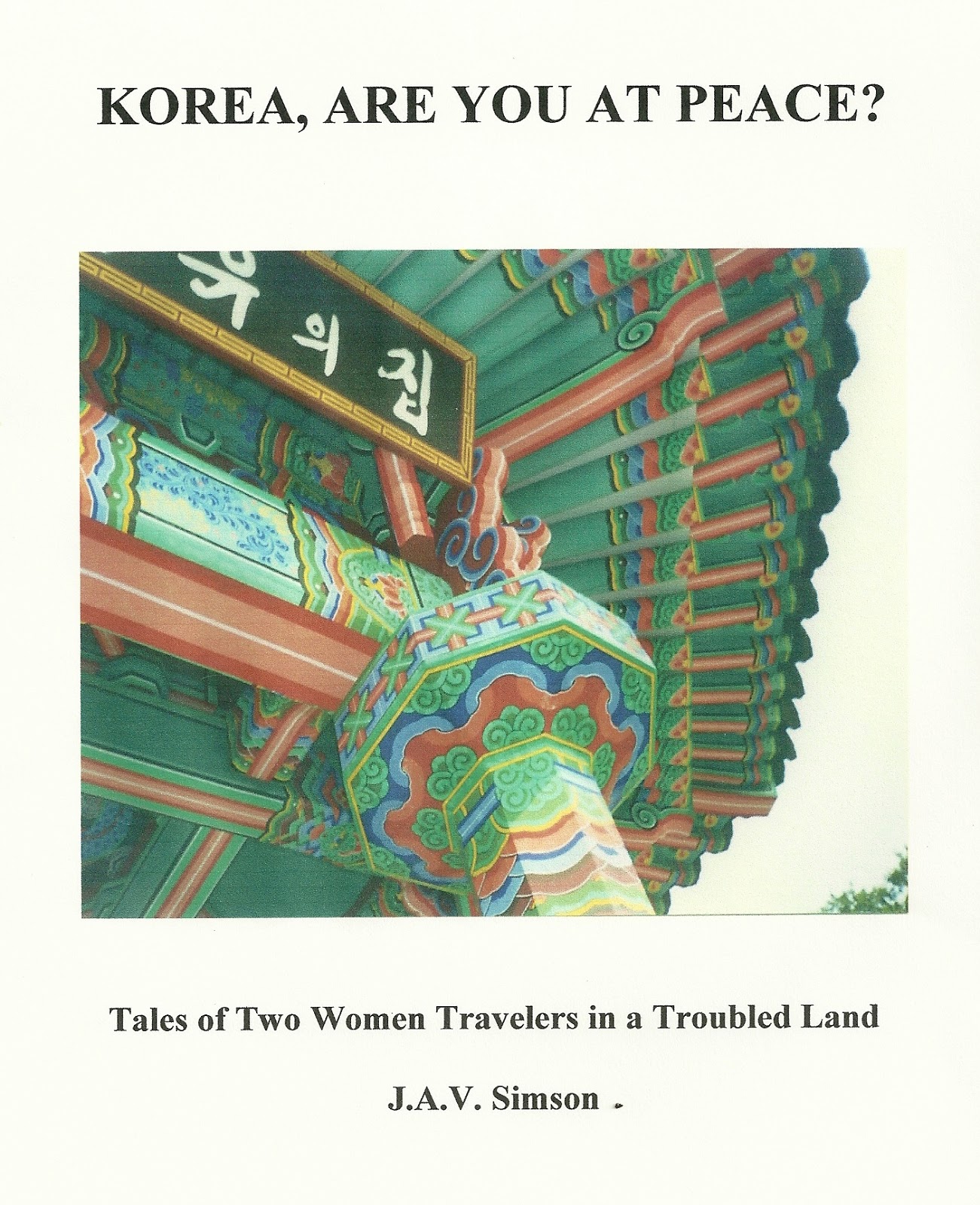
Korea, Are You at Peace? Tales of Two Women Travelers in a Troubled Land


I’m interrupting the series on the organ tour of southern France to post a blurb on a book just submitted to the publisher last week. The intense final efforts to finish this baby (while also doing taxes) were largely responsible for my being MIA in the blogosphere for nearly two months.

You might not think a modern woman scientist and a Victorian travel writer would have much in common. Yet in this travel memoir, I find myself channeling Isabella Bird Bishop, a nineteenth century adventuress, who visited some of the same Korean countryside I did a century later. The Korea I visited was no longer her mysterious Hermit Kingdom of Asia but rather a divided and dangerous world. During the century between our visits, Korea was abandoned by China, deceived by Russia (and by the U.K. and U.S.), annexed by Japan, and finally 'liberated' by the USSR and the U.N. Subsequently, the peninsula was subjected to a devastating three year war and further fractured by Cold War ideology. The Korean War, in fact, never officially ended.

This peninsula has recently emerged onto the world stage as both an economic success story (South Korea) and an ideological, political nightmare (North Korea). Korea, Are You at Peace? is the personal story of a Western woman living in the East, observing and trying to understand twenty-first century Korea and its culture, as viewed against a historical backdrop provided by a late-nineteenth century woman travel writer. Insights of others who chronicled the devastating twentieth century in Korea are included in the narrative.

Korea, Are You at Peace recounts my experiences as a teacher and U.S. military contractor, living, working, and traveling for two years in South Korea.  I came to admire the courage and endurance of the Korean people, but it was impossible not to sense their pain and anger, nor to marvel at their extraordinary energy and resilience. Several intentions underlie my desire to make these experiences public.

  • To provide a brief, readable, historical overview of Korea, with the hope that Americans may better understand the country—its past and its people.
  • To compare Korea, the reclusive Hermit Kingdom of Asia at the turn of the 20th century, with a radically altered Korea at the turn of the 21st century—a divided peninsula and a political tinderbox.
  • To describe what it is like to be an American military contractor in a foreign land and to offer insight into the cultural discord engendered by an American military presence on a local foreign population.
  • To narrate the often humorous challenges of a Western woman traveling alone in East Asia.

For a concise, accurate, and sympathetic history of the Korean peninsula, read the Appendix of this book. For an engaging narrative of Korea and its past century, read the whole book.