Stonehenge

Stonehenge
Showing posts with label Cavaille-Coll. Show all posts

Sunday, August 25, 2013

Pipedreams, Southern France, Day 10

Wednesday, May 19 – the next-to-last day of the tour. We traveled by bus to several towns around Toulouse.

Cathedral Saint-Alain: simple, bold exterior

 
The first stop was Lavaur, where we visited the Cathedral Saint-Alain, an impressive, southern gothic structure (13th – 16th centuries) set in a broad green lawn with formal gardens. The interior was probably the most elaborately decorated of those I have seen: painted walls, elaborate ceiling decorations, pulpit highlighted with gold leaf, and marble panels.
Gilded organ loft, Saint-Alain
http://www.youtube.com/watch?v=DrrYnp7iH1E


The great organ was a Cavaille-Coll, restored in the late 20th century. It has a good, powerful sound. The choir organ has not been renovated and doesn’t work.


Eglise Saint-Francois, shops abut the exterior
Also in the town of Lavaur was the Eglise Saint-Francois, again constructed between the 13th and 16th centuries. Dwellings and shops crowded its walls from all sides.
 
 
Eglise Saint-Francois with
elaborate internal painted arches
http://www.youtube.com/watch?v=Xp907VqGmaU


Internally, it seemed (to me) too elaborate for a Franciscan church, St. Francis being the model (next to Jesus) of unpretentious simplicity.
The organ, built by Puget in the late 19th century, was restored early this century. The organ had a nice, light tone that was marred, particularly in softer sections, by the sound of nearby construction.


Eglise Saint-Martin, beautifully painted interior


After lunch, we visited Castelnau d’Estretefonds and the Eglise Saint-Martin. The church dates from the 16th century, but the beautifully preserved, painted interior was accomplished during the late 19th century.  The organ is a Cavaille-Coll finished in the late 19th century and recently restored. The organ had a nice sound, with unusual bell tones.


Eglise Saint Michael, simple exterior

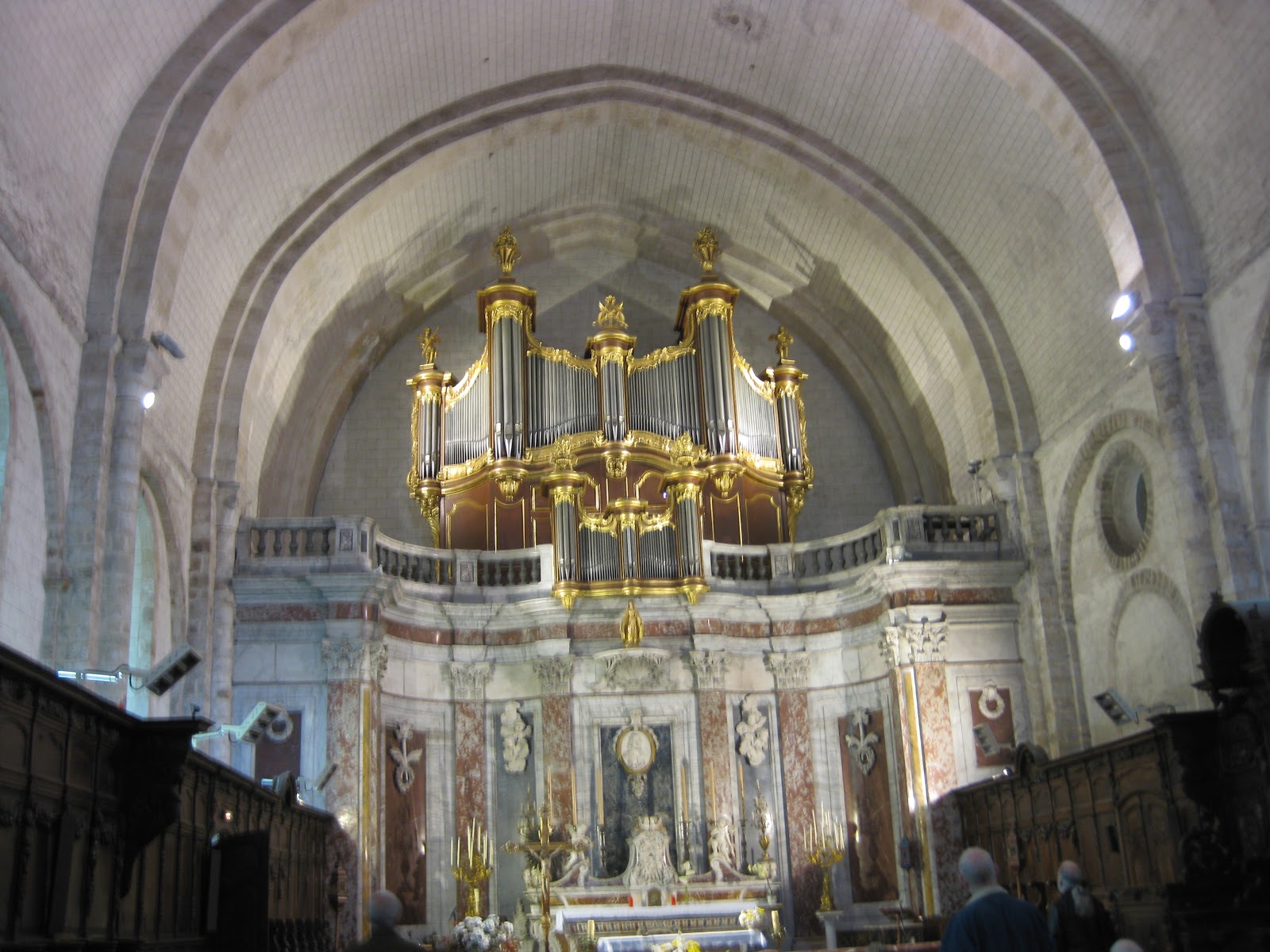
Our final stop of the day was Verdun-sur-Garonne, where we visited the Eglise Saint-Michel.
 
 
Eglise Saint-Michael, beautifully painted interior
http://www.youtube.com/watch?v=dkqnN_ECNBA
 
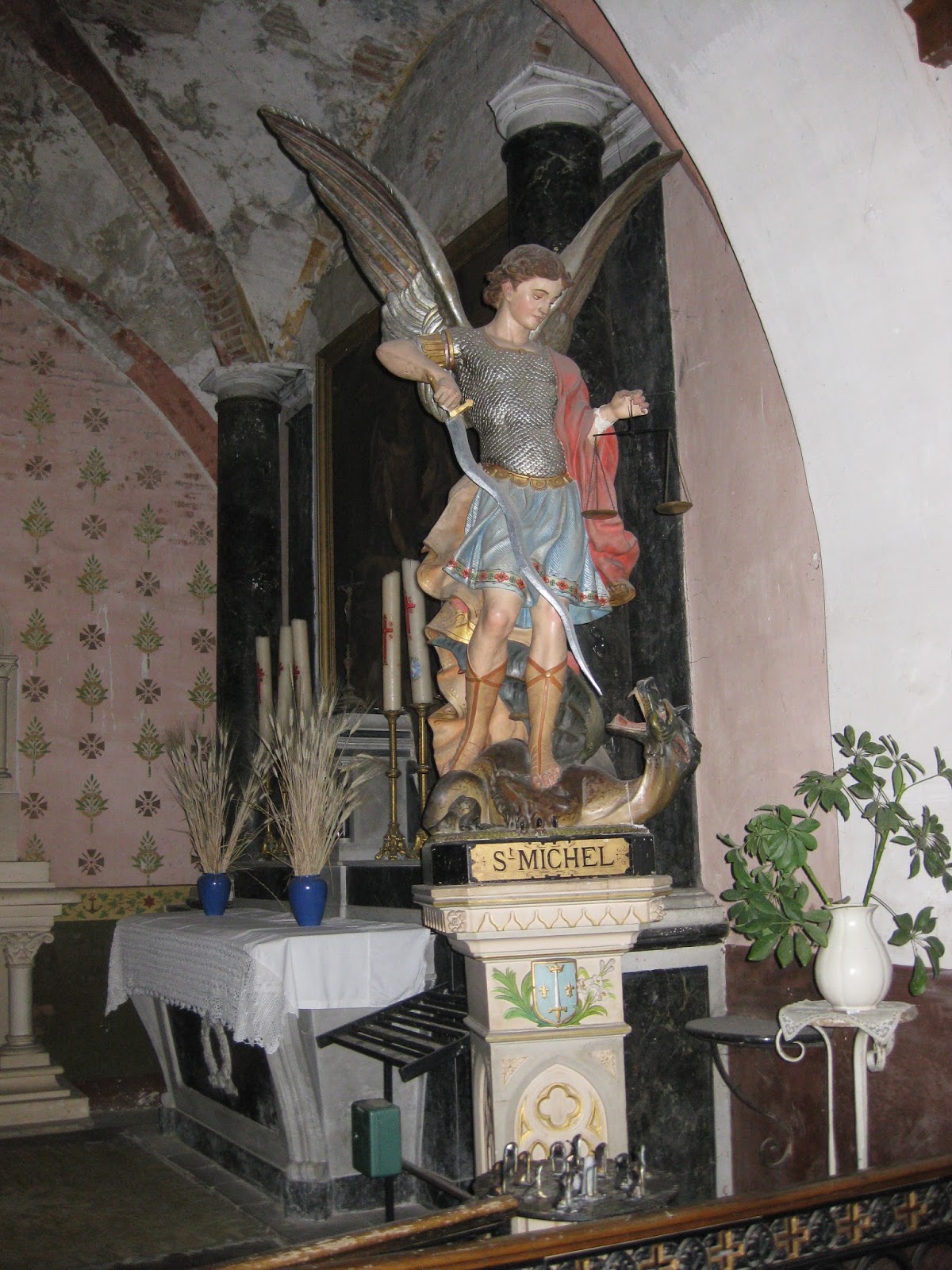
The painted interior is a stunning blue with religious images in the spandrels of ceiling arches. An almost life-sized statue of St. Michael was killing a dragon (I thought it was St. George who killed the dragon).The organ was a 18th baroque century baroque jewel by J.-F. Lepine, restored in the 20th century, is nearly in the same condition as when it was built.
 

Monday, February 18, 2013

Pipedreams Organ Tour - Day 7


Cathedrale Saint-Pons de Cimiez, exterior
 
After leaving Beziers on Sunday, May 16 (Day 7 of the tour), we drove into the mountains to the town of Saint-Pons-de-Thomieres, to visit the Cathedrale Saint-Pons de Cimiez on our way to Carcassonne, perhaps the most extraordinary town in all of France (possibly next to Paris).
Magnificent gilded baroque organ and inlaid marble walls,
interior of Cathedrale Saint-Pons de Cimiez

The organ in the Cathedrale Saint-Pons de Cimiez is a baroque instrument, built in 1771 by Micot and Son; it was restored in the 1980s, but all the original features (pipes, casing, stops) have been retained. It is a magnificent looking organ and one of the oldest we have seen and heard. Although the exterior of the church has a simple Romanesque style, the interior is clearly baroque, with gilding and abundant inlaid marble on walls and fixtures.
Michael Barone at the console, Saint-Pons
From Saint-Pons, we drove on to the fairy-tale city of Carcassonne, which is one of my two favorite cities/towns in France, along with Strasbourg. The sky was overcast as we approached the city, so I couldn’t get a good, well-lit photo of the iconic walled medieval city. We visited three churches in the city.
The medieval walled city of Carcasonne
The first church was the Cathedrale Saint-Michel, which boasts two organs--a great organ and a choir organ--both built by Cavaille-Coll in the mid-19th century. The organist played some very dramatic pieces; intense sound filling the church, then some lighter pieces, perhaps improvisations, that included clear, enchanting tones of bells and cymbals. The church was very dark and musty, and they may have been doing some remodeling; I had to leave before the presentation was over because of a paroxysm of coughing in reaction to the dust, mold and incense that pervaded the interior space
Organ, Cathedrale Saint-Michel
The next church we visited was the Eglise Saint-Vincent, where I waited by the side for the others to come. I had left the other church before group members had played because the smell in the church was causing me to cough, sneeze, and wheeze. The rain had pretty much let up, and the sun came out briefly, but dark, ominous clouds covered it once again. This is another fortress-like church, but in the middle of the city. Again, the church had a great organ and a choir organ, originally built in the early 18th century, modified by Cavaille and Cavaille-Coll in the late 18th century, and then completely rebuilt by Puget in the 19th century. Several in the group played a Widor piece on this organ. The high notes had a very pure tone; the sound was mellow in the middle range, and the lower chords almost seemed to overwhelm the space. According to AB Culver, the reverberation was greater in this church than in any of the others we’d visited. So the combination of the organ and the space gave the music a very special sound and feel.
Beautiful stained glass windows in the
Eglise Saint-Vincent
Finally, we went into the walled city of Carcassonne itself. There the church was the Basilique Saint-Nazaire, whose original organ was built in 1637. It has been overhauled and restored several times since then by notable organ builders. The sound of the organ was good, but not as dramatic or melodic or versatile as some of the other instruments we’ve heard so far. The church was very dark inside, so I didn’t get a decent picture of the organ, but I did manage to get good potos of stained glass windows in this church and the previous one. Walking up and down the city's narrow passageways with a few others in the group, I took as many photos of the city as I could before dark set in. It touched my deepest sense of self and personal continuity as I relived--in memory and imagination--my other trip to Carcassonne in 1957, more than a half century ago.
Striking stained-glass windows,
Basilique Saint-Nazaire, Carcasonne
I couldn't find any links to organ recordings done in the churches and cathedrals we visited this Sunday, May 16. Sorry, Folks!  Ian, your YouTube Pipedreams Southern France recordings 24 - 28 seem to be missing!

The magic city of Carcasonne, twilight

Tuesday, October 16, 2012

Pipedreams organ tour, Day 2


On the second day of the Pipedreams tour (Tuesday, May 11), we visited five different churches in five different towns in Provence, all in the vicinity of Marseilles. This seemed like a bit of a forced march to me, as I’m used to taking vacations in a leisurely and exploratory fashion.
Libbie at Notre Dame de l’Assomption

The first town was Barjols, and the church was the Collegiale Notre-Dame de l’Assomption. It was built into a town square, with commercial buildings sharing its walls. The interior was simple, but the organ was ancient, having been built in 1657 and restored in 1837. Several modifications were made in the later 19th and 20th century, but these were “reversed” in 1986, giving the organ its authentic functions and old, rich tone.

Organ at Basilique Sainte-Marie-Madeleine
http://www.youtube.com/watch?v=AoV6UNwvcjc&feature=relmfu

The second town was Saint-Maximin la Sainte-Baume, where we visited the Basilique Sainte-Marie-Madeleine (I’m not fabricating any of these names!). The organ was an Isnard organ, built during the last half of the 18th century, so another very old organ whose original pipes have all been preserved, despite several restorations. This is the legendary site where Mary Magdalene, with her brother, Lazarus, landed on a boat trip from the Holy Land and established a Christian colony. A reliquary contains a skull and shin bone, with the epithet: “Noli me tangere.” The crypt contains sarcophagi purporting to contain the remains of Saints Maximin, Sidonius, and Mary Magdelaine.
Organ, Eglise St-Vincent
http://www.youtube.com/watch?v=oTfL6KLMElc&feature=channel
 
The next town on the itinerary was Roquevaire, and the organ was in the Eglise Saint-Vincent. It is a new organ, built in 1993, re-using some pipes. It boasts a total of 5,000 pipes and operates with electric action. The sound is huge and dramatic, and fills the large church with sound. Bell and percussion sounds chime from the high registers. John Claude played a storm scene on the organ that was almost overpowering.      
 
The next town (the fourth) was Bouc-Bel-Air, where the Eglise Saint-Andre sported a much more simple organ, again a new one, completed in 2006. It is a small organ with a good sound (although tinny in spots).
Organ, Eglise St-Andre
http://www.youtube.com/watch?v=ie9nVVZQoPs&feature=channel
The fifth and final stop for the day was in Aix-en-Provence, at the Cathedral Saint-Sauveur. Several organs have been installed in this cathedral, beginning in the 15th century, with the latest restoration in the early 21st century. Several master organists have had a hand in renovations and restorations, including Jean-Esprit Isnard and Aristide Cavaille-Coll, two famous French organ producers. The interior of the cathedral was very dark; the organist, Chantal de Zeeuw, played a piece by a female student of Cesar Frank. The cathedral itself is built upon the foundations of a temple to Apollo.
 Again, the links to YouTube videos were done by Ian Cook, who took sound and videos of many of the organs and their churches.


Cathedral Saint-Sauveur, Aix-en-Provence, outside and inside, with organ loft and pipes.
http://www.youtube.com/watch?v=7TIVyIymyiM&feature=plcp