Stonehenge

Stonehenge
Showing posts with label Organs. Show all posts

Sunday, August 25, 2013

Pipedreams, Southern France, Day 10

Wednesday, May 19 – the next-to-last day of the tour. We traveled by bus to several towns around Toulouse.

Cathedral Saint-Alain: simple, bold exterior

 
The first stop was Lavaur, where we visited the Cathedral Saint-Alain, an impressive, southern gothic structure (13th – 16th centuries) set in a broad green lawn with formal gardens. The interior was probably the most elaborately decorated of those I have seen: painted walls, elaborate ceiling decorations, pulpit highlighted with gold leaf, and marble panels.
Gilded organ loft, Saint-Alain
http://www.youtube.com/watch?v=DrrYnp7iH1E


The great organ was a Cavaille-Coll, restored in the late 20th century. It has a good, powerful sound. The choir organ has not been renovated and doesn’t work.


Eglise Saint-Francois, shops abut the exterior
Also in the town of Lavaur was the Eglise Saint-Francois, again constructed between the 13th and 16th centuries. Dwellings and shops crowded its walls from all sides.
 
 
Eglise Saint-Francois with
elaborate internal painted arches
http://www.youtube.com/watch?v=Xp907VqGmaU


Internally, it seemed (to me) too elaborate for a Franciscan church, St. Francis being the model (next to Jesus) of unpretentious simplicity.
The organ, built by Puget in the late 19th century, was restored early this century. The organ had a nice, light tone that was marred, particularly in softer sections, by the sound of nearby construction.


Eglise Saint-Martin, beautifully painted interior


After lunch, we visited Castelnau d’Estretefonds and the Eglise Saint-Martin. The church dates from the 16th century, but the beautifully preserved, painted interior was accomplished during the late 19th century.  The organ is a Cavaille-Coll finished in the late 19th century and recently restored. The organ had a nice sound, with unusual bell tones.


Eglise Saint Michael, simple exterior

Our final stop of the day was Verdun-sur-Garonne, where we visited the Eglise Saint-Michel.
 
 
Eglise Saint-Michael, beautifully painted interior
http://www.youtube.com/watch?v=dkqnN_ECNBA
 
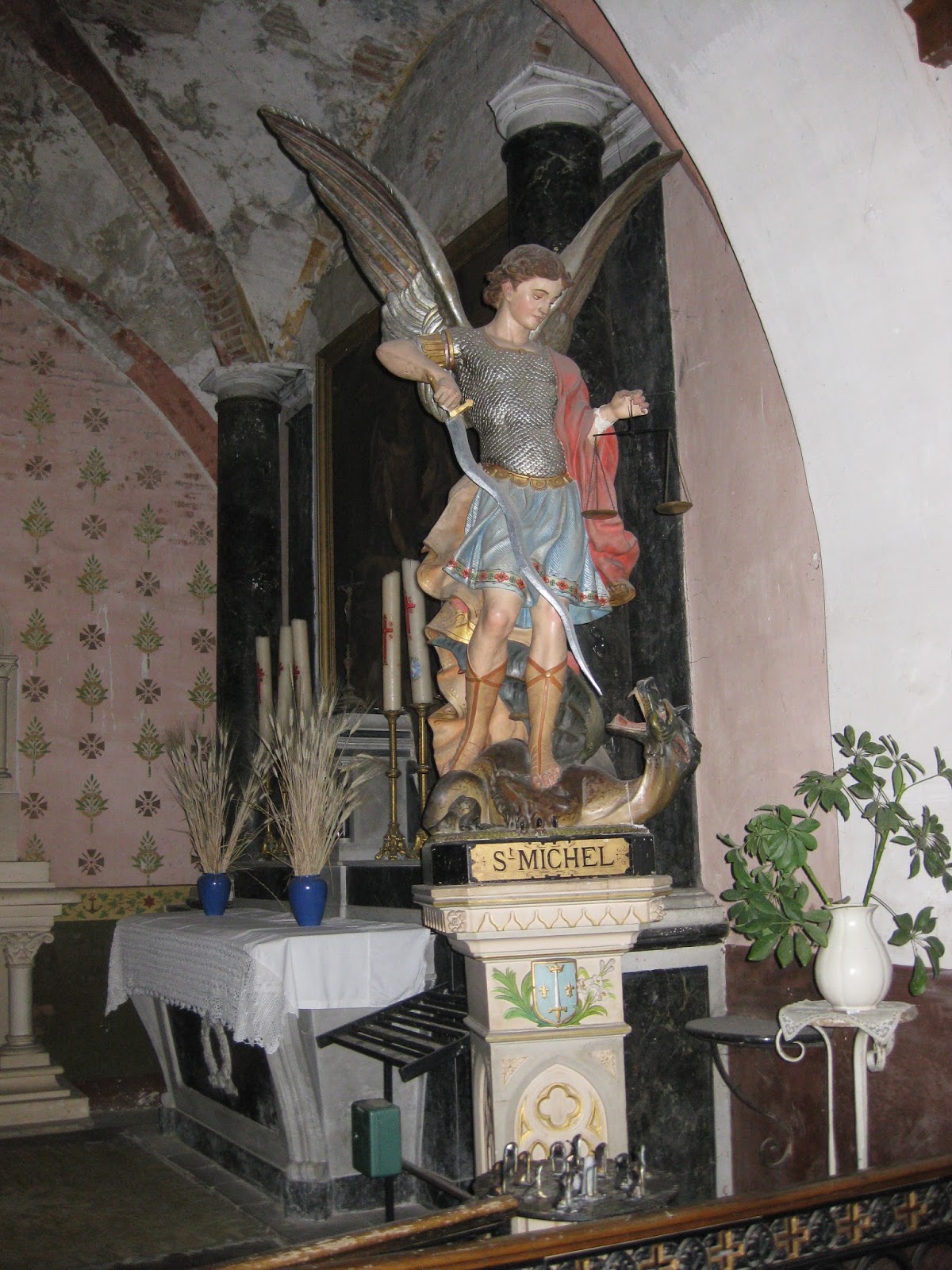
The painted interior is a stunning blue with religious images in the spandrels of ceiling arches. An almost life-sized statue of St. Michael was killing a dragon (I thought it was St. George who killed the dragon).The organ was a 18th baroque century baroque jewel by J.-F. Lepine, restored in the 20th century, is nearly in the same condition as when it was built.
 

Monday, February 18, 2013

Pipedreams Organ Tour - Day 7


Cathedrale Saint-Pons de Cimiez, exterior
 
After leaving Beziers on Sunday, May 16 (Day 7 of the tour), we drove into the mountains to the town of Saint-Pons-de-Thomieres, to visit the Cathedrale Saint-Pons de Cimiez on our way to Carcassonne, perhaps the most extraordinary town in all of France (possibly next to Paris).
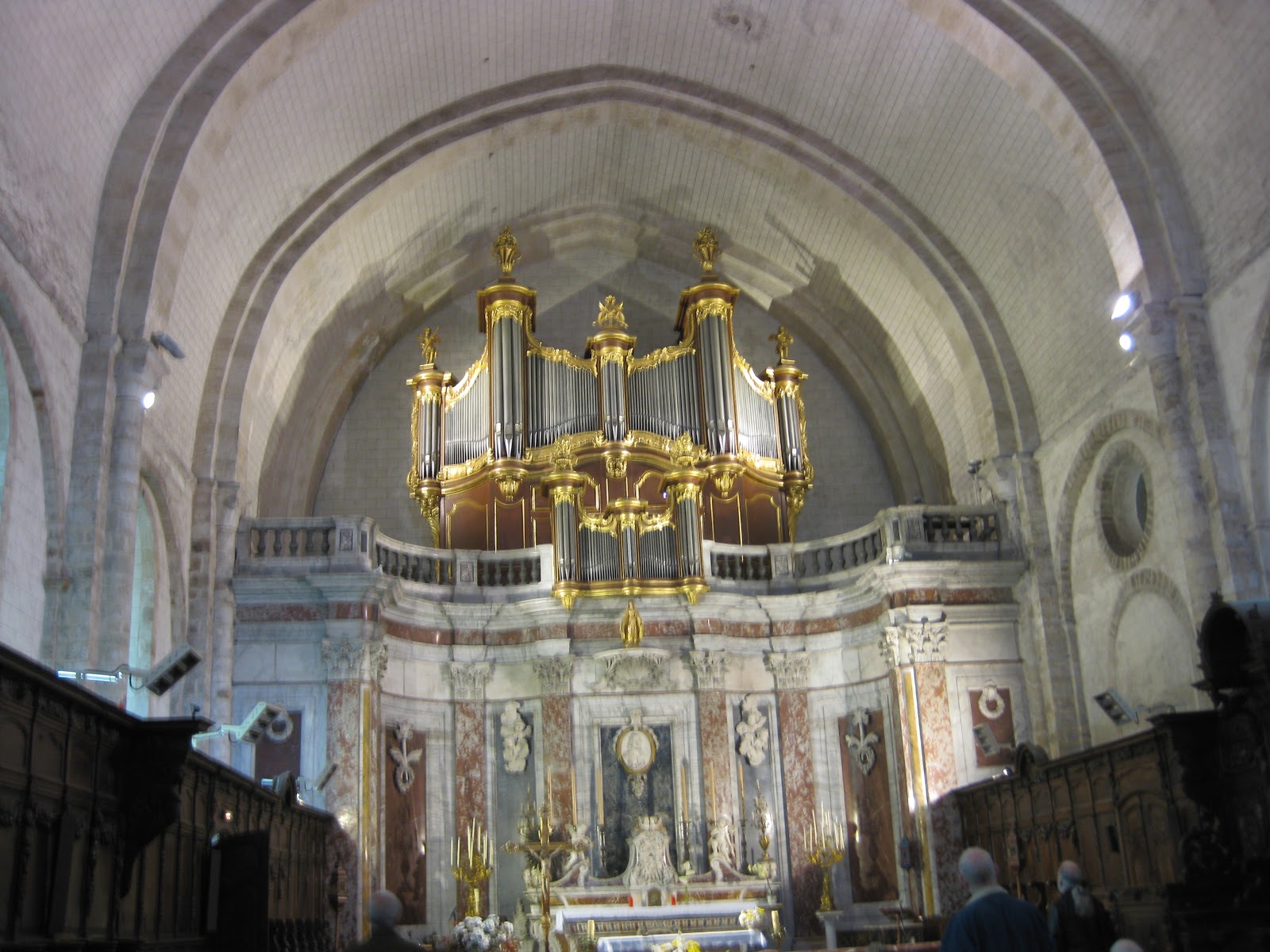
Magnificent gilded baroque organ and inlaid marble walls,
interior of Cathedrale Saint-Pons de Cimiez

The organ in the Cathedrale Saint-Pons de Cimiez is a baroque instrument, built in 1771 by Micot and Son; it was restored in the 1980s, but all the original features (pipes, casing, stops) have been retained. It is a magnificent looking organ and one of the oldest we have seen and heard. Although the exterior of the church has a simple Romanesque style, the interior is clearly baroque, with gilding and abundant inlaid marble on walls and fixtures.
Michael Barone at the console, Saint-Pons
From Saint-Pons, we drove on to the fairy-tale city of Carcassonne, which is one of my two favorite cities/towns in France, along with Strasbourg. The sky was overcast as we approached the city, so I couldn’t get a good, well-lit photo of the iconic walled medieval city. We visited three churches in the city.
The medieval walled city of Carcasonne
The first church was the Cathedrale Saint-Michel, which boasts two organs--a great organ and a choir organ--both built by Cavaille-Coll in the mid-19th century. The organist played some very dramatic pieces; intense sound filling the church, then some lighter pieces, perhaps improvisations, that included clear, enchanting tones of bells and cymbals. The church was very dark and musty, and they may have been doing some remodeling; I had to leave before the presentation was over because of a paroxysm of coughing in reaction to the dust, mold and incense that pervaded the interior space
Organ, Cathedrale Saint-Michel
The next church we visited was the Eglise Saint-Vincent, where I waited by the side for the others to come. I had left the other church before group members had played because the smell in the church was causing me to cough, sneeze, and wheeze. The rain had pretty much let up, and the sun came out briefly, but dark, ominous clouds covered it once again. This is another fortress-like church, but in the middle of the city. Again, the church had a great organ and a choir organ, originally built in the early 18th century, modified by Cavaille and Cavaille-Coll in the late 18th century, and then completely rebuilt by Puget in the 19th century. Several in the group played a Widor piece on this organ. The high notes had a very pure tone; the sound was mellow in the middle range, and the lower chords almost seemed to overwhelm the space. According to AB Culver, the reverberation was greater in this church than in any of the others we’d visited. So the combination of the organ and the space gave the music a very special sound and feel.
Beautiful stained glass windows in the
Eglise Saint-Vincent
Finally, we went into the walled city of Carcassonne itself. There the church was the Basilique Saint-Nazaire, whose original organ was built in 1637. It has been overhauled and restored several times since then by notable organ builders. The sound of the organ was good, but not as dramatic or melodic or versatile as some of the other instruments we’ve heard so far. The church was very dark inside, so I didn’t get a decent picture of the organ, but I did manage to get good potos of stained glass windows in this church and the previous one. Walking up and down the city's narrow passageways with a few others in the group, I took as many photos of the city as I could before dark set in. It touched my deepest sense of self and personal continuity as I relived--in memory and imagination--my other trip to Carcassonne in 1957, more than a half century ago.
Striking stained-glass windows,
Basilique Saint-Nazaire, Carcasonne
I couldn't find any links to organ recordings done in the churches and cathedrals we visited this Sunday, May 16. Sorry, Folks!  Ian, your YouTube Pipedreams Southern France recordings 24 - 28 seem to be missing!

The magic city of Carcasonne, twilight

Saturday, January 26, 2013

Pipedreams Organ Tour, Day 6


Lunel: Eglise Notre-Dame du Lac
 
On day six (Saturday, May 15), we left Nîmes and headed deeper into Languedoc, to the town of Lunel. Our first stop was the Eglise Notre-Dame du lac; this church boasted another 19th century Cavaille-Coll organ. Lunel was considered a troubadour town. The image of St. Bernadette is in the grotto and one of Mary is in a side chapel.
Organ, Eglise Notre-Dame du Lac

Our next stop, Saint-Guilhem-le-Desert, with its church, Abbaye Saint-Guilhem, was perhaps my favorite spot of the whole tour. It is an absolutely enchanting village, high in the southern French hills. It felt more spiritually intense to me than any other we visited – perhaps because it was embedded in wilderness and blended with it. Flowers, particularly poppies, grew out of rocky outcroppings and constructed stone hedges indifferently, and in the middle of the town was a very ancient platane (plane tree or sycamore) that had already been measured at 6 meters (~ 6 yards) in circumference in 1855. The abbey so enchanted one of the Rockefellers, that he moved part of it, in toto, to New York. There it forms the nucleus of The Cloisters in upper Manhattan, the world-renowned museum of medieval art. The organ was beautiful, with mellow low tones - if a bit tinny in the higher register. Apparently, with its “cuneiform bellows” one can only play music from the classical period. I wish I could include many photos from this gorgeous town. Maybe in another blog post.
Saint-Guilhem-le-Desert

The last two stops of the day were in Montpellier, Cathedrale Saint-Pierre, and Beziers, Cathedrale Saint-Nazaire. The Cathedrale Saint-Pierre is very large, a true cathedral, and the organ, a restored early 19th century Cavaille, has a very rich sound throughout its range and reverberates extensively in the huge stone building. The organist did have some technical problems, though, and had to stop the concert. I did not get an in-focus photo of the organ, but did get a couple of photo of the massive nave and stained-glass windows.
Abbaye Saint-Guilhem, organ
http://www.youtube.com/watch?v=kobAL9FRqwc&list=UUep1YKxL0oqmDxkPkeKZLHw


Thecathedral in Beziers was begun in the 13th century, on a site where many Catholics and Cathars were slaughtered in 1209. St. Dominic led a “crusade” against the Cathars – an “heretical” group in southern France – and that crusade is seen by many as the beginning of the Inquisition. There was some WWII veterans’ celebration at the cathedral as we were arriving, which delayed our entry. I took no notes on the sound of the organ, but the play of light from stained-glass windows onto the church pillars was captivating.

Montpellier, Cathedrale Saint-Pierre
http://www.youtube.com/watch?v=p1qE_rUbQlc&list=UUep1YKxL0oqmDxkPkeKZLHw

Again, Ian Cook, our intrepid organ aficionado from Australia, made the organ recordings and posted them on YouTube.


Sunday, January 6, 2013

Pipedreams Organ Tour, Day 5b


Pipedreams group, amphitheater at Nimes
 
From Uzès, we drove to Nîmes, once the Roman colony of Nemausus, which boasts some of the best-preserved Roman structures outside of Rome itself, including a huge aqueduct (the spectacular Pont du Gard), a well preserved Roman temple, and a large amphitheater, still used for community events (including bull-fights). We visited the aqueduct first, which was amazingly intact for a two-thousand-year old structure of that size. It crosses the Gard River, and in antiquity, it carried water from Nîmes to Avignon. The aqueduct was a tourist draw, but uncrowded, as were the other Roman structures we visited. I recommend Nîmes as a destination for those interested in ancient Roman artifacts who don’t like to hassle the crowds. The Roman temple, called the “square house” of Nîmes, was built in 02– 05 AD when Augustus was emperor.

Pont du Gard, Nîmes


The two churches (with organs) we visited that day (Friday, May 14) in Nîmes were the Église Saint-Paul and the Cathédrale Notre-Dame & Saint-Castor. Both had classic Cavaille-Coll organs (19th century) which have been recently restored, to good effect.

The organ in the Église Saint-Paul was one of my favorites of the entire trip. The low, vibrating tones resonate through the church and through the body, giving a reassuring sense of grandeur and protection, as if the tones offered the power of a massive, surrounding shield. Even the higher, lighter tones of the organ have a masculine sound.


The Cathédrale Notre-Dame & Saint-Castor was a Romanesque cathedral built in the 11th century, partly destroyed during the religious wars (Reformation), and reconstructed in the 17th century. It was embedded in a conglomerate of buildings in the center of the city, with shops attached to its walls like accretions or parasites on the side of a whale. The church was quite dark inside, and I couldn’t get a good, in-focus picture of the organ. Moreover, the organ seemed to have a rather more tinny sound than some of the others we’ve heard.


Monday, December 17, 2012

Pipedreams Organ Tour, Day 5a


5/14/10
"On the bus between Avignon and Nimes, three days into the organ trip of southern France.  This trip has been interesting on several levels: the locales visited, the organ music, the travelers (26 individualistic – I could even say eccentric – organ aficionados, although only about half of them actually play the organ), the history (papal schisms, the Albigensian “heresy”), and of course, the opportunity to learn things I know very little about.”
The above was the only paragraph I managed to write in my journal during the entire Pipedreams organ tour in southern France. We were up and out early every morning, going all day long, and then bussed back exhausted and overwhelmed by our experiences. I usually just collapsed in the hotel bed. I was glad to have had a single room, with no roommate to chat with or keep me awake.
We had spent two nights in Avignon, and the better part of two days visiting churches in the vicinity and listening to their organs, most of which were newly built. The tour through the Popes’ Palace was an enlightening foray into history and religion.
Temple Saint-Martial in Avignon,ancient ruins outside

On the morning of Friday, May 14, we visited another church in Avignon, the Temple Saint-Martial. This is a protestant church, but was originally the church of a Benedictine monastery. Again, the organ is a new one, built by our contemporary organ builder, Pascal Quoirin. In this case, the cabinetry for the metal pipes is quite modern in design, unlike that in the Collegiale Saint-Martin in Saint-Remy. The organ had an enormous, full tone with the stops out. Also, it had a hand bellows, not used for most of the music, although we heard one piece with hand-pumped air, and the sound was large and full. In general, the lower tones were very mellow, although in the higher registers the pipes seemed somewhat shrill. All in all, the sound was as good as, or better than, most of the older organs we have heard.
Modern organ inside Temple Saint-Martial
http://www.youtube.com/watch?v=PBbckUE2Tyg

From Provence, we crossed into the province of Languedoc, the center of the Albigensian heresy that convulsed southern France for a more than a century. It seems that the Crusade against this “heresy” by the Catholic Church in the 13th century, and its efforts to stamp out heresy thereafter, ultimately gave rise to the Inquisition that swung into full force during the Protestant Reformation.
Cathedrale Saint-Theodorit

The second church we visited on Friday was the Cathedrale Saint-Theodorit at Uzès. The church is a very old one, begun in the 11th century, and mostly destroyed in the 17th century, all except for the bell tower. The bell tower reminds me of the towers of early Christian churches on the east coast of Italy – in Ravenna. The organ is also an old one, constructed originally in the late 17th century, probably when the church was rebuilt. The organ has been restored twice, in the 19th and 20th centuries, with the aim of recapturing its original sound and elegance. The organ has a good tone, and its gilded casing is the most elaborate I've seen so far on the tour.

Again, I've linked recordings of the organs made by Ian Cook and uploaded to YouTube, as well as a recording of the Saint Theodorit organ by Finoskov Productions that illustrates both its magnificant tone and the exquisite baroque cabinetry.
Elaborate17th-century gilded organ cabinetry
http://www.youtube.com/watch?v=scDtNldaenU
http://www.youtube.com/watch?NR=1&v=pVOaDmj9RiE&feature=endscreen


Friday, August 24, 2012

Organ Tour, Part 1 - Marseilles


5/21/10 et seq.

I had essentially NO time during the organ tour to record events and impressions, nor to finish writing about the Italy trip, so I’ll try to do as much of that as possible on this train trip and for the couple of days in London. I will fly out of Heathrow (God willing and the ash-cloud doesn’t return) on Monday morning for Kiev. Hopefully, on that trip, I’ll have more time to write as we ply Russia’s rivers and canals.

I’ll try to reconstruct the extraordinary tour of the south of France (Le Midi) and its marvelous organs from a few tidbits of journal entries, from photographs, and from brief notes scribbled in the booklet for the tour: “Historic Organs of Southern France,” May 9 – 21, 2010, with Michael Barone. American Public Media, Pipedreams. I took lots of photos, and these should help refocus the memory.

Nave of Eglise Saint-Vincent-de-Paul
.

My photo strategy for the organ tour was to take a couple of photos of a church from the outside, then a couple of the nave inside, and then a couple of the organ, or more specifically, the pipes and casing or cabinetry. If there was something of particular interest in the church itself – special décor, ancient baptismal font, striking stained-glass windows – I often took photos of that, too. In some cases, I used a video camera (which “disappeared” in Russia) and recorded video and sound, as well.
Organ loft, Eglise Saint-Vincent-de-Paul
The Pipedreams Organ Tour began in the shadow of the Icelandic ash cloud for many of those on the tour, as had this whole trip for me. A few of the participants couldn’t get air flights from Paris to Marseilles and had to take the train. Others were delayed in London and arrived a day late in Marseilles. I arrived the evening before most of the group in the city of Marseilles - once the ancient Greek port of Massilia, and now the largest city of Provence and the second largest city in France. I met Eddie, one of the trip regulars, that first evening and we met again at breakfast.
Eglise Saint-Vincent-de-Paul, Marseilles, France
It turns out that many of those on the tour (perhaps half of them) are Michael Barone groupies and return year after year to visit organs in various parts of the world (mostly Europe), to listen to them, often to play them, and to enjoy one another’s idiosyncratic company and the chance to share a passion for music in their own individualistic manner. There were 22 members of the group (or 23, counting Lise Schmidt, Michael’s significant other of 32 years), as well as three leaders – Michael Barone, the host of Pipedreams on Minnesota Public Radio (which airs on Sunday afternoons in Charleston); Janet Tollund, who led our tour and usually organizes the Pipedreams tours (through her tour company, Accolades), although she usually doesn’t lead the tour itself; and Jean-Claude Guidarini, an accomplished organist from Toulouse, who was apparently the major musical contact for the tour, who knew most of the titular organists and organ builders, and who was usually the first person to play the organ (sometimes after the titular organist) to show off its possibilities with skilled improvisations.
Ancient fortifications above the harbor
Eventually I came to realize that several of the churches we visited had once been catholic cathedrals, converted to protestant churches. It was not always clear, however, which were which. Initially it seemed that church (eglise) signalled a protestant church, and cathedrale (or abbaye or basilique) indicated a catholic church, although, in retrospect, I’m dubious of these distinctions. The south of France has had a complex and contorted religious history, with the Albigensian heresy at the center of much persecution and bloodshed, in addition to the Catholic schism with Rome during which popes took up residency in Avignon, followed eventually by the protestant reformation, which was bloody in this part of Europe – perhaps even bloodier than elsewhere.