Stonehenge

Stonehenge
Showing posts with label Michael Barone. Show all posts

Saturday, June 15, 2013

Pipedreams, Southern France, Day 9


Package ready to mail, Pont Neuf across the Garonne River, Toulose
 
The next three days and nights we spent in the vicinity of Toulouse, the major city of Midi-Pyrenees. In the city of Toulouse itself, we were scheduled to visit seven churches. The third one on the schedule was cancelled, and I decided to opt out of the last three because I was tired. Instead, I chose to wander around the city a bit by myself, to buy a couple of souvenirs, and to mail a package of books and souvenirs back to the U.S. Again, YouTube video-recordings by Ian Cook are linked.

Eglise Notre-Dame la Dalbade, exterior with tympanum
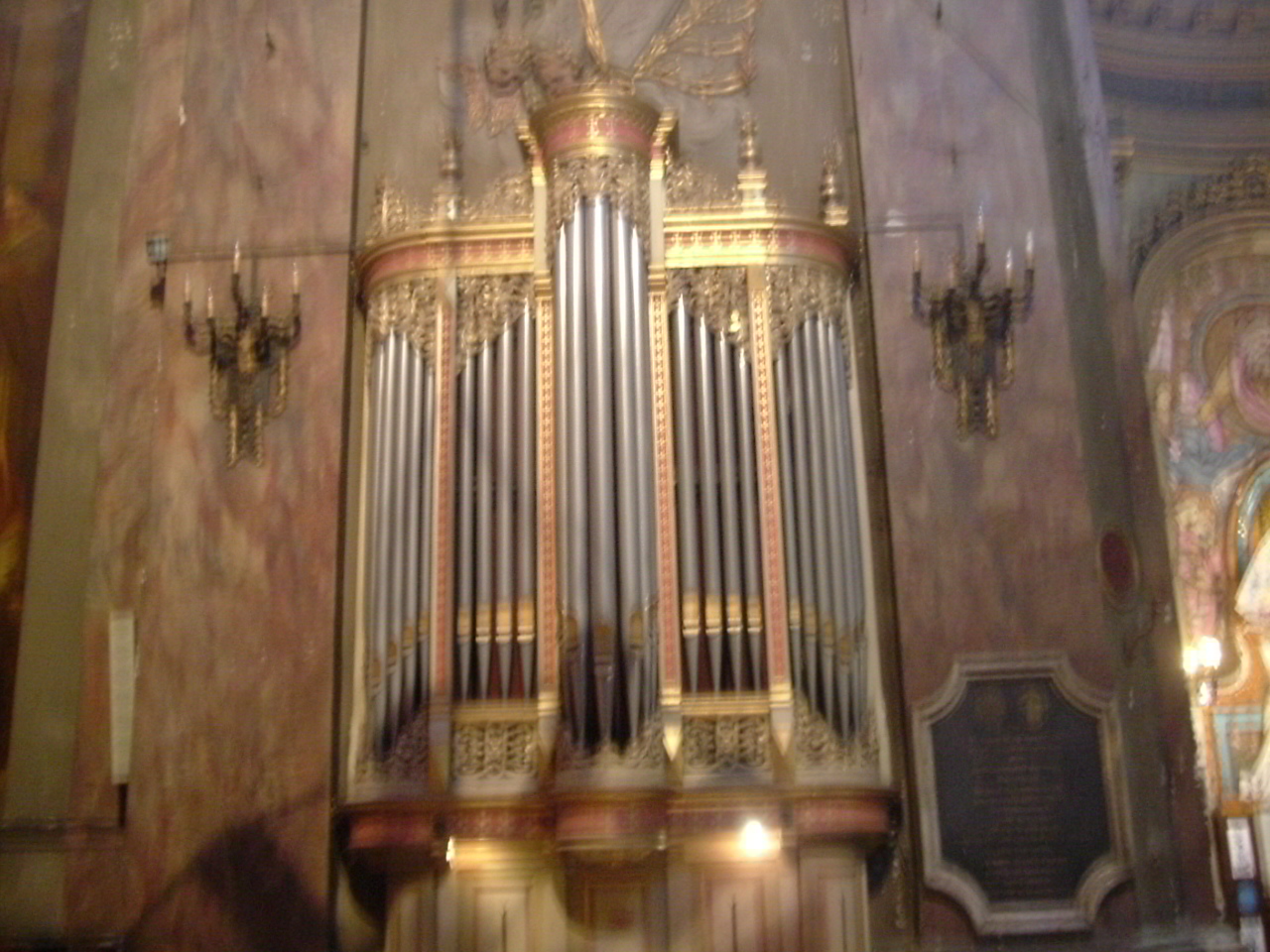
The first church we visited in Toulouse (Tuesday, May 18) was the Eglise Notre-Dame la Dalbade. The church was built in the late 15th century, but sustained some damage in 1926 when the bell tower collapsed. The tympanum over the door is a Renaissnace ceramic rendition of the crowning of the Virgin by Fra Angelico. The organ, reconstructed by Puget in the late 19th century, was given its initiation in concert by the well-known composer, Charles-Marie Widor, in 1888. It has just recently been carefully restored. The organ has a wide dramatic range, almost heroic tones in the base. The organist (M. Demiguel) also demonstrated its versatility with some “modern” music of traffic sounds, battle sounds, and screams of despair. It has a huge base sound that reverberates through the floor and into the feet and legs. One of the group members played the famous Widor piece, which plays well on this organ.
Organ loft, Eglise Notre-Dame la Dalbade
http://www.youtube.com/watch?v=ODSd32tzjiM
 

The next church was a protestant church, the Temple du Salin, an unimposing structure on the corner of a city block. It was very light inside, and easy to photograph. The organ was designed by our organist, Jean-Claude Guidarini, and built by Jean Daldosso early this century. It has clear, bell-like tones in the higher registers and sturdy tones in the lower. The organ and its casings were quite beautifully and simply presented.
 
Temple du Salin: simple exterior


Beautiful organ, Temple du Salin
http://www.youtube.com/watch?v=wLod23NGYP4


The Basilique Notre-Dame la Daurade was a fairly new church (19th century) in a neoclassical style, built on the site of a former Roman temple of Apollo which had been replaced by a temple to the virgin, which collapsed in the 18th century. I couldn’t get a good photo of the great organ, but had more luck with the choir organ. Jean Claude and Michael played a duet (Vierne mass?) on the great and choir organs respectively. The choir organ seemed to have a sweeter sound.
 
Choir organ, Basilique Notre-Dame la Daurade
Notre-Dame la Daurade: neoclassical façade
 

Pipedreams Organ Tour, Day 8


JAVS and Janet Tollund enjoying the sky and clouds, Collegiale Saint-Vincent
On May 17th (the eighth day of the tour) we left Carcassonne on the bus, taking a route to Toulouse that meandered through several small towns nestled in the Pyrenees, and that led from the province of Langedoc to Midi-Pyrenees. Again, some links to Ian Cook's wonderful YouTube video recordings are included.
Collegiale Saint-Vincent, southern French gothic exterior
 

Our first stop was Montreal de L’Aude, where we visited the Collegiale Saint-Vincent. The organ there is the product of three centuries of construction and reconstruction by several famous organ builders. It was a magnificent-looking organ. Jean-Claude did an improvisation that showed the very flexible sound of the instrument that performed well with both classical and contemporary music. Unfortunately, again, some strong smell inside the church (furniture polish?) drove me outside before I could hear the full range of its possibilities. I sat on a ledge near the entrance, watching clouds pass overhead behind the gargoyles.
Organ, Collegiale Saint-Vincent,
 
 
The next church was the Collegiale Saint-Michel in the town of Castelnaudary. The organ was originally built in the late 18th century by Cavaille (baroque style) and was rebuilt in the 19th century by his grandson, Cavaille-Coll (romantic style), and restored in the late 20th century. It has very nice tones; slow pieces showed off its sweet sounds in slow pieces, and the good, unobtrusive reverberations of the space. The church was light and white inside, clean, with beautiful stained glass windows, almost clear glass along the walls of the nave and beautifully painted, arched ceilings along the side aisles.
Collegiale Saint-Michel, Castelnaudary
The third church we stopped at was the Cathedrale Saint-Maurice in Mirepoix. The town of Mirepoix was charming, with medieval, half-timbered houses surrounding the church and marketplace. This was the only organ of German origin (brothers Link) that we heard on the tour, I believe. It was built in the late 19th century. It is apparently unreconstructed and does not have electric bellows. It is not as large as some others we’ve seen, but it produces a good sound for the space. One can, however hear the tapping and clacking of pedals and keys if the music is soft.
Organ, Collegiale Saint-Michel
http://www.youtube.com/watch?v=1V9cx5Spkig
Next, we went to the town of Foix, to listen to the organ in the Eglise Saint-Volusien. The church is a very old one, begun in 1111 by Roger II upon returning from the Crusades. It was damaged during the wars of religion in the 14th century and restored in the 17th century. The church is light inside, but the organ loft is dark. The organ has a pretty sound, different from most of those we’ve heard so far, with clear tones and a deep base (a 32’ soubise?).
Organ, Cathedrale Saint-Maurice
http://www.youtube.com/watch?v=Xm6SzoDKjFk
Organ, Eglise Saint-Volusien
http://www.youtube.com/watch?v=68EWynW053U
 
Organ, Eglise de la Nativite de la Vierge


The final church of the day was the Eglise de la nativite de la Vierge in the town of Cintegabelle. The organ has a long and checkered history. The case displays a great many pipes, but I made no notes about the sound of the instrument. The church has an ancient lead baptismal font from the 13th century.

Thirteenth century baptismal font

Friday, August 24, 2012

Organ Tour, Part 1 - Marseilles


5/21/10 et seq.

I had essentially NO time during the organ tour to record events and impressions, nor to finish writing about the Italy trip, so I’ll try to do as much of that as possible on this train trip and for the couple of days in London. I will fly out of Heathrow (God willing and the ash-cloud doesn’t return) on Monday morning for Kiev. Hopefully, on that trip, I’ll have more time to write as we ply Russia’s rivers and canals.

I’ll try to reconstruct the extraordinary tour of the south of France (Le Midi) and its marvelous organs from a few tidbits of journal entries, from photographs, and from brief notes scribbled in the booklet for the tour: “Historic Organs of Southern France,” May 9 – 21, 2010, with Michael Barone. American Public Media, Pipedreams. I took lots of photos, and these should help refocus the memory.

Nave of Eglise Saint-Vincent-de-Paul
.

My photo strategy for the organ tour was to take a couple of photos of a church from the outside, then a couple of the nave inside, and then a couple of the organ, or more specifically, the pipes and casing or cabinetry. If there was something of particular interest in the church itself – special décor, ancient baptismal font, striking stained-glass windows – I often took photos of that, too. In some cases, I used a video camera (which “disappeared” in Russia) and recorded video and sound, as well.
Organ loft, Eglise Saint-Vincent-de-Paul
The Pipedreams Organ Tour began in the shadow of the Icelandic ash cloud for many of those on the tour, as had this whole trip for me. A few of the participants couldn’t get air flights from Paris to Marseilles and had to take the train. Others were delayed in London and arrived a day late in Marseilles. I arrived the evening before most of the group in the city of Marseilles - once the ancient Greek port of Massilia, and now the largest city of Provence and the second largest city in France. I met Eddie, one of the trip regulars, that first evening and we met again at breakfast.
Eglise Saint-Vincent-de-Paul, Marseilles, France
It turns out that many of those on the tour (perhaps half of them) are Michael Barone groupies and return year after year to visit organs in various parts of the world (mostly Europe), to listen to them, often to play them, and to enjoy one another’s idiosyncratic company and the chance to share a passion for music in their own individualistic manner. There were 22 members of the group (or 23, counting Lise Schmidt, Michael’s significant other of 32 years), as well as three leaders – Michael Barone, the host of Pipedreams on Minnesota Public Radio (which airs on Sunday afternoons in Charleston); Janet Tollund, who led our tour and usually organizes the Pipedreams tours (through her tour company, Accolades), although she usually doesn’t lead the tour itself; and Jean-Claude Guidarini, an accomplished organist from Toulouse, who was apparently the major musical contact for the tour, who knew most of the titular organists and organ builders, and who was usually the first person to play the organ (sometimes after the titular organist) to show off its possibilities with skilled improvisations.
Ancient fortifications above the harbor
Eventually I came to realize that several of the churches we visited had once been catholic cathedrals, converted to protestant churches. It was not always clear, however, which were which. Initially it seemed that church (eglise) signalled a protestant church, and cathedrale (or abbaye or basilique) indicated a catholic church, although, in retrospect, I’m dubious of these distinctions. The south of France has had a complex and contorted religious history, with the Albigensian heresy at the center of much persecution and bloodshed, in addition to the Catholic schism with Rome during which popes took up residency in Avignon, followed eventually by the protestant reformation, which was bloody in this part of Europe – perhaps even bloodier than elsewhere.