Stonehenge

Stonehenge
Showing posts with label Southern France. Show all posts

Tuesday, September 17, 2013

Pipedreams, Southern France, Day 11


On the eleventh and final day of our Pipedreams organ tour (Thursday, May 20), we again visited towns surrounding Toulouse. We also had the chance to visit the workshop of an organ builder, Jean Daldoso. Again, links to the organ recordings are thanks to Ian Cook, our companion from the southern hemisphere. For anyone who would like to review and listen to Ian's recordings, they can be found at: http://www.youtube.com/user/Southfrancepipedream/videos


Eglise Saint-Roch & Saint-Blaise
http://www.youtube.com/watch?v=lVDwMKiYcGw

Our first stop was in the town of Seysses, where we visited the Eglise Saint-Roch & Saint-Blaise. The church, which had been quite small, was enlarged in the late 18th century, and has an elaborate baroque interior. The organ was another Puget, built in the mid-19th century, and restored in the early 21st century by Daldosso, whose workshop we visited later that day. The acoustics of the church seem to genuinely enhance the organ’s sound; however, I didn’t get a good photograph of the organ.
 
 
Louis Schrady admiring a mural
Eglise Saint-Roch & Saint-Blaise


The next church, Eglise Notre-Dame de l’Assomption, was in the town of Gimont. This church is in the southern Gothic style, graced with beautiful stained glass windows. The organ has had several builders and repairers and was recently restored; its sound was nice, but not as spectacular as some we have heard on the trip. It may have been partly the interior acoustics.


Tower, Eglise Notre-Dame de l’Assomption


Exquisite stained glass window,
Eglise Notre-Dame de l’Assomption
http://www.youtube.com/watch?v=RJiI9MxtYzA


 We then had the privilege of visiting the workshop of organ-builder Jean Daldoso in Gimont. They were in the process of restoring a small house organ.


Workshop of Jean Daldoso, Gimont


The last stop of the day, and the last church/organ for the trip, was in Auch, the Cathedrale Sainte-Marie. It is a huge, impressive church, both externally and internally, in high, flamboyant Gothic style, with renaissance and even baroque décor. This may have been the largest, most elaborate church we visited during the entire tour. The high alter and choir areas were separated by a rood screen from the main nave. We had to pay to enter that area, with its beautifully carved oak choir stalls, half a millennium old, and haut-relief figures along the walls. The church had a great organ and a choir organ. The great organ was initially built by Jean de Joyeuse in the late 17th century, and modified and repaired several times since then, most recently by Cavaille-Coll in the 19th century. It was restored and reconstructed with electrified stops in 1994, three centuries after its initial installation. The great organ was a fine, powerful instrument, and served as an interesting contrast to the choir organ. The latter was built in 1858, and had a beautiful, clear tone; it was also capable of power and brilliance.
Cathedrale Sainte-Marie at Auch, nave
http://www.youtube.com/watch?v=qyD465wLaeY
Interior of Cathedrale Sainte-Marie at Auch,
elaborate haut-relief figures and statuary in
marble and alabaster - a baroque feast


Organ pipes above the rood screen
Cathedrale Sainte-Marie at Auch
http://www.youtube.com/watch?v=iMrXxA2ogSI
 

Me (Jo Anne) next to the tiny choir organ console.


Saturday, June 15, 2013

Pipedreams, Southern France, Day 9


Package ready to mail, Pont Neuf across the Garonne River, Toulose
 
The next three days and nights we spent in the vicinity of Toulouse, the major city of Midi-Pyrenees. In the city of Toulouse itself, we were scheduled to visit seven churches. The third one on the schedule was cancelled, and I decided to opt out of the last three because I was tired. Instead, I chose to wander around the city a bit by myself, to buy a couple of souvenirs, and to mail a package of books and souvenirs back to the U.S. Again, YouTube video-recordings by Ian Cook are linked.

Eglise Notre-Dame la Dalbade, exterior with tympanum
The first church we visited in Toulouse (Tuesday, May 18) was the Eglise Notre-Dame la Dalbade. The church was built in the late 15th century, but sustained some damage in 1926 when the bell tower collapsed. The tympanum over the door is a Renaissnace ceramic rendition of the crowning of the Virgin by Fra Angelico. The organ, reconstructed by Puget in the late 19th century, was given its initiation in concert by the well-known composer, Charles-Marie Widor, in 1888. It has just recently been carefully restored. The organ has a wide dramatic range, almost heroic tones in the base. The organist (M. Demiguel) also demonstrated its versatility with some “modern” music of traffic sounds, battle sounds, and screams of despair. It has a huge base sound that reverberates through the floor and into the feet and legs. One of the group members played the famous Widor piece, which plays well on this organ.
Organ loft, Eglise Notre-Dame la Dalbade
http://www.youtube.com/watch?v=ODSd32tzjiM
 

The next church was a protestant church, the Temple du Salin, an unimposing structure on the corner of a city block. It was very light inside, and easy to photograph. The organ was designed by our organist, Jean-Claude Guidarini, and built by Jean Daldosso early this century. It has clear, bell-like tones in the higher registers and sturdy tones in the lower. The organ and its casings were quite beautifully and simply presented.
 
Temple du Salin: simple exterior


Beautiful organ, Temple du Salin
http://www.youtube.com/watch?v=wLod23NGYP4


The Basilique Notre-Dame la Daurade was a fairly new church (19th century) in a neoclassical style, built on the site of a former Roman temple of Apollo which had been replaced by a temple to the virgin, which collapsed in the 18th century. I couldn’t get a good photo of the great organ, but had more luck with the choir organ. Jean Claude and Michael played a duet (Vierne mass?) on the great and choir organs respectively. The choir organ seemed to have a sweeter sound.
 
Choir organ, Basilique Notre-Dame la Daurade
Notre-Dame la Daurade: neoclassical façade
 

Pipedreams Organ Tour, Day 8


JAVS and Janet Tollund enjoying the sky and clouds, Collegiale Saint-Vincent
On May 17th (the eighth day of the tour) we left Carcassonne on the bus, taking a route to Toulouse that meandered through several small towns nestled in the Pyrenees, and that led from the province of Langedoc to Midi-Pyrenees. Again, some links to Ian Cook's wonderful YouTube video recordings are included.
Collegiale Saint-Vincent, southern French gothic exterior
 

Our first stop was Montreal de L’Aude, where we visited the Collegiale Saint-Vincent. The organ there is the product of three centuries of construction and reconstruction by several famous organ builders. It was a magnificent-looking organ. Jean-Claude did an improvisation that showed the very flexible sound of the instrument that performed well with both classical and contemporary music. Unfortunately, again, some strong smell inside the church (furniture polish?) drove me outside before I could hear the full range of its possibilities. I sat on a ledge near the entrance, watching clouds pass overhead behind the gargoyles.
Organ, Collegiale Saint-Vincent,
 
 
The next church was the Collegiale Saint-Michel in the town of Castelnaudary. The organ was originally built in the late 18th century by Cavaille (baroque style) and was rebuilt in the 19th century by his grandson, Cavaille-Coll (romantic style), and restored in the late 20th century. It has very nice tones; slow pieces showed off its sweet sounds in slow pieces, and the good, unobtrusive reverberations of the space. The church was light and white inside, clean, with beautiful stained glass windows, almost clear glass along the walls of the nave and beautifully painted, arched ceilings along the side aisles.
Collegiale Saint-Michel, Castelnaudary
The third church we stopped at was the Cathedrale Saint-Maurice in Mirepoix. The town of Mirepoix was charming, with medieval, half-timbered houses surrounding the church and marketplace. This was the only organ of German origin (brothers Link) that we heard on the tour, I believe. It was built in the late 19th century. It is apparently unreconstructed and does not have electric bellows. It is not as large as some others we’ve seen, but it produces a good sound for the space. One can, however hear the tapping and clacking of pedals and keys if the music is soft.
Organ, Collegiale Saint-Michel
http://www.youtube.com/watch?v=1V9cx5Spkig
Next, we went to the town of Foix, to listen to the organ in the Eglise Saint-Volusien. The church is a very old one, begun in 1111 by Roger II upon returning from the Crusades. It was damaged during the wars of religion in the 14th century and restored in the 17th century. The church is light inside, but the organ loft is dark. The organ has a pretty sound, different from most of those we’ve heard so far, with clear tones and a deep base (a 32’ soubise?).
Organ, Cathedrale Saint-Maurice
http://www.youtube.com/watch?v=Xm6SzoDKjFk
Organ, Eglise Saint-Volusien
http://www.youtube.com/watch?v=68EWynW053U
 
Organ, Eglise de la Nativite de la Vierge


The final church of the day was the Eglise de la nativite de la Vierge in the town of Cintegabelle. The organ has a long and checkered history. The case displays a great many pipes, but I made no notes about the sound of the instrument. The church has an ancient lead baptismal font from the 13th century.

Thirteenth century baptismal font

Wednesday, March 20, 2013

Pipedreams Organ Tour - Day 8


On May 17th (the eighth day of the tour) we left Carcassonne on the bus, taking a route to Toulouse that meandered through several small towns nestled in the Pyrenees, and that led from the province of Langedoc to Midi-Pyrenees.
Collegiale Saint-Vincent

Our first stop was Montreal de L’Aude, where we visited the Collegiale Saint-Vincent with its well-preserved typical southern French Gothic exterior. The organ there is the product of three centuries of construction and reconstruction by several famous organ builders. It was a magnificent-looking organ with a huge organ case. Jean-Claude did an improvisation that showed the very flexible sound of the instrument. It performed well with both classical and contemporary music. Unfortunately, again, some strong smell inside the church (furniture polish?) drove me outside before I could hear the full range of its possibilities. I sat on a ledge near the entrance, watching clouds pass overhead behind the gargoyles.
Organ case, C. St-Vincent

The next church was the Collegiale Saint-Michel in the town of Castelnaudary. The organ was originally built in the late 18th century by Cavaille (baroque style) and was rebuilt in the 19th century by his grandson, Cavaille-Coll (romantic style), and restored in the late 20th century. It has very nice tones; slow pieces showed off the sweetness of the sound and the good, unobtrusive reverberations of the space. The church was light and white inside, clean, with beautiful stained glass windows, almost clear glass along the walls of the nave and beautifully painted, arched ceilings along the side aisles.
Collegial Saint Michel
I couldn't find a YouTube recording of the organ at Collegial Saint-Vincent, but Ian Cook did a fine recording of the organ at Collegiale Saint-Michel in Castelnaudary as well as the other organs on this day. I've tried to link the music to the word "organ"in the text; the photo captions with links were too long. We'll see if this works. You should probably try to open it in a new tab, which you can do if you right-click on the link.
Cathedral Saint Maurice
The third church we stopped at was the Cathedrale Saint-Maurice in Mirepoix. The town of Mirepoix was charming, with medieval, half-timbered houses surrounding the church and marketplace. I believe this was the only organ of German origin (brothers Link) that we heard on the tour. It was built in the late 19th century and is apparently unreconstructed and does not have electric bellows. It is not as large as some others we’ve seen, but it produces a good sound for the space. One can, however, hear the tapping and clacking of keys and pedals if the music is soft.
Eglise Saint-Volusien
Next, we went to the town of Foix, to listen to the organ in the Eglise Saint-Volusien. The church is a very old one, begun in 1111 by Roger II upon returning from the Crusades. It was damaged during the wars of religion in the 14th century and restored in the 17th century. The church is light inside, but the organ loft is dark. The organ has a pretty sound, different from most of those we’ve heard so far, with clear tones and a deep base (a 32’ soubise?).
Eglise de la Nativite de la Vierge

The final church of the day was the Eglise de la Nativite de la Vierge in the town of Cintegabelle. The organ has a long and checkered history. The case displays a great many pipes, but I made no notes about the sound of the instrument. The church boasts an ancient lead baptismal font from the 13th century.
13th century baptismal font


Sunday, November 4, 2012

Pipedreams Organ Tour, Day 3


  After a very pleasant dinner , we spent the night in Aix-en-Provence.
The following morning (Wednesday, May 12) we visited another church in Aix, the Eglise Saint-Jean-de-Malte. Unfortunately, I didn’t bring my camera into the church, which was beautiful, with ogival arches and very light inside. On one wall was a painting by Delacroix, which I would love to have photographed. Again, the organ in this church was a new one, simple, with an elegant arrangement of the pipes. Jean-Claude played variations on “Twinkle, Twinkle,” a delightfully irreverent tune that suited the organ’s abilities.

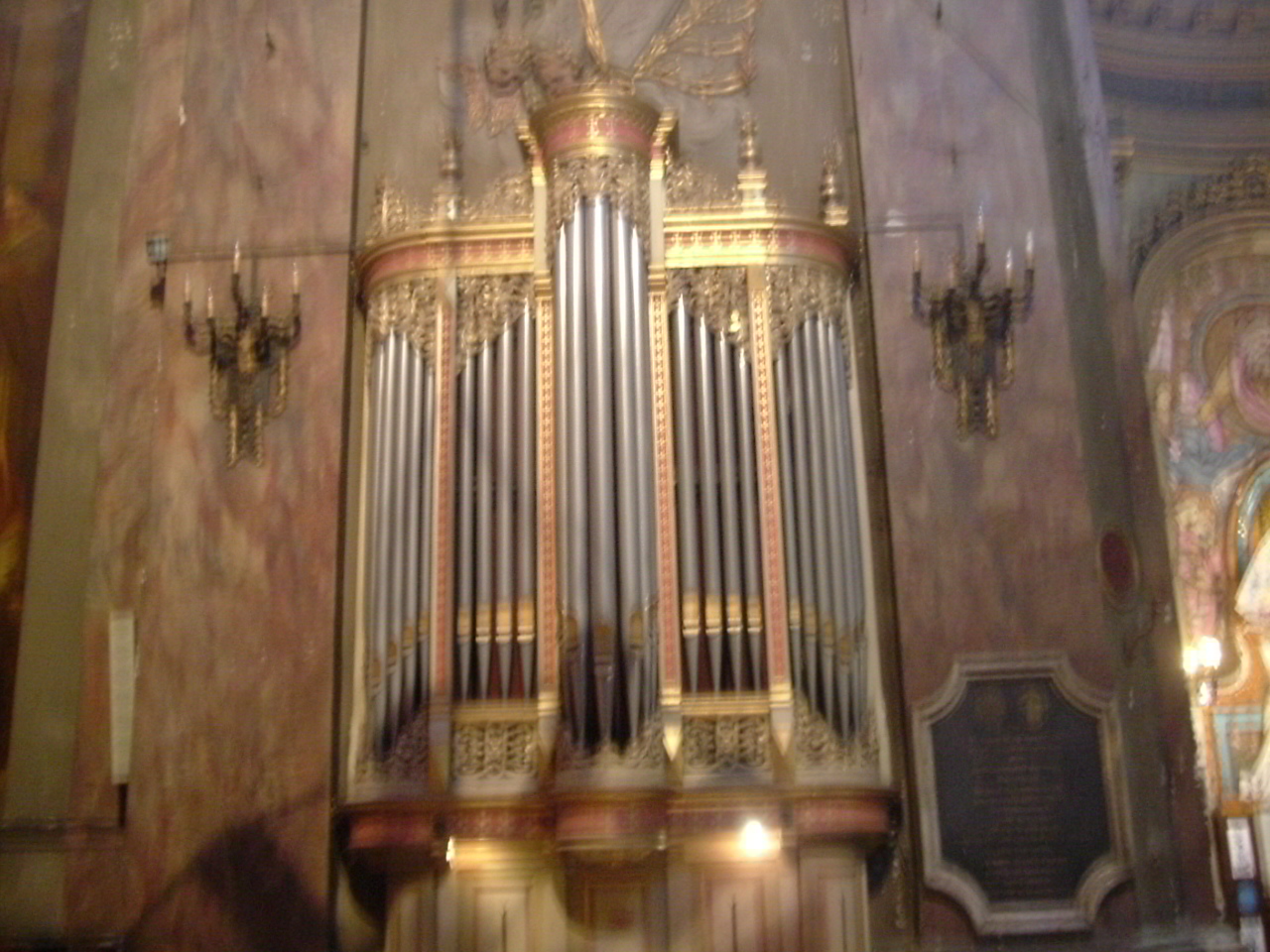
From there, we went to Beaucaire, to the Eglise Notre-Dame des Pommiers, a baroque structure that scarcely looks like a church from the outside. The organ was built in 1849, using an even older case. It was restored between 1986 and ’88 and is considered an “Historical Monument.”
http://www.youtube.com/watch?v=CM0ICStqOok&playnext=1&list=PLC6F133B57E5CAF89&feature=results_video


Notre-Dame des Pommiers, organ pipes.
The next stop (third church of the day) was Roquemaure, the Collegiale Saint-Jean-Baptiste. This is an old church, with an old organ, apparently constructed in the 17th century and transferred to the church in the 19th century. The pipes are very well preserved, and the organ was restored in 1989. The church claims the remains of Saint Valentine (moved there in 1868). I wonder what lovers fought over those remains and where they were originally! The structure of the pipe assembly includes elements of both Spanish and Italian style organs; lovely stained windows illuminate the sanctuary.
Roquemaure, Collegiale Saint-Jean-Baptiste
http://www.youtube.com/watch?v=bRgL5rJb8-8&feature=BFa&list=PLC6F133B57E5CAF89


After Roquemaure, we went to an organ builder’s workshop, Pascal Quoirin, a fascinating behind-the scenes glimpse at the guts of those magnificent music-makers. We saw two disassembled organs: one, being restored, from the cathedral at Toulon, and one being newly constructed for the Church of the Ascension (Episcopal?) in New York. We saw cabinetry, pipes and pipe construction, reeds and shallots. The many different types of pipes – tapered (trumpets), constant diameter, with and without reeds, the kinds of pipes in wood or metal – mostly tin (Sn) with about 10% lead (Pb) and even some (~0.1%) gold (Au). It seems that hammered and unhammered tin have different hardness and different sound.


Organ builder’s workshop, Pascal Quoirin

After the workshop visit, we went into the city of Avignon, where we were to spend the night in a hotel. The rest of the group went  to the cathedral (Notre-Dame des Doms), but I didn’t go; I was tired and wanted to take a shower and go to bed.

Tuesday, October 16, 2012

Pipedreams organ tour, Day 2


On the second day of the Pipedreams tour (Tuesday, May 11), we visited five different churches in five different towns in Provence, all in the vicinity of Marseilles. This seemed like a bit of a forced march to me, as I’m used to taking vacations in a leisurely and exploratory fashion.
Libbie at Notre Dame de l’Assomption

The first town was Barjols, and the church was the Collegiale Notre-Dame de l’Assomption. It was built into a town square, with commercial buildings sharing its walls. The interior was simple, but the organ was ancient, having been built in 1657 and restored in 1837. Several modifications were made in the later 19th and 20th century, but these were “reversed” in 1986, giving the organ its authentic functions and old, rich tone.

Organ at Basilique Sainte-Marie-Madeleine
http://www.youtube.com/watch?v=AoV6UNwvcjc&feature=relmfu

The second town was Saint-Maximin la Sainte-Baume, where we visited the Basilique Sainte-Marie-Madeleine (I’m not fabricating any of these names!). The organ was an Isnard organ, built during the last half of the 18th century, so another very old organ whose original pipes have all been preserved, despite several restorations. This is the legendary site where Mary Magdalene, with her brother, Lazarus, landed on a boat trip from the Holy Land and established a Christian colony. A reliquary contains a skull and shin bone, with the epithet: “Noli me tangere.” The crypt contains sarcophagi purporting to contain the remains of Saints Maximin, Sidonius, and Mary Magdelaine.
Organ, Eglise St-Vincent
http://www.youtube.com/watch?v=oTfL6KLMElc&feature=channel
 
The next town on the itinerary was Roquevaire, and the organ was in the Eglise Saint-Vincent. It is a new organ, built in 1993, re-using some pipes. It boasts a total of 5,000 pipes and operates with electric action. The sound is huge and dramatic, and fills the large church with sound. Bell and percussion sounds chime from the high registers. John Claude played a storm scene on the organ that was almost overpowering.      
 
The next town (the fourth) was Bouc-Bel-Air, where the Eglise Saint-Andre sported a much more simple organ, again a new one, completed in 2006. It is a small organ with a good sound (although tinny in spots).
Organ, Eglise St-Andre
http://www.youtube.com/watch?v=ie9nVVZQoPs&feature=channel
The fifth and final stop for the day was in Aix-en-Provence, at the Cathedral Saint-Sauveur. Several organs have been installed in this cathedral, beginning in the 15th century, with the latest restoration in the early 21st century. Several master organists have had a hand in renovations and restorations, including Jean-Esprit Isnard and Aristide Cavaille-Coll, two famous French organ producers. The interior of the cathedral was very dark; the organist, Chantal de Zeeuw, played a piece by a female student of Cesar Frank. The cathedral itself is built upon the foundations of a temple to Apollo.
 Again, the links to YouTube videos were done by Ian Cook, who took sound and videos of many of the organs and their churches.


Cathedral Saint-Sauveur, Aix-en-Provence, outside and inside, with organ loft and pipes.
http://www.youtube.com/watch?v=7TIVyIymyiM&feature=plcp