Stonehenge

Stonehenge
Showing posts with label Pipedreams. Show all posts

Sunday, August 25, 2013

Pipedreams, Southern France, Day 10

Wednesday, May 19 – the next-to-last day of the tour. We traveled by bus to several towns around Toulouse.

Cathedral Saint-Alain: simple, bold exterior

 
The first stop was Lavaur, where we visited the Cathedral Saint-Alain, an impressive, southern gothic structure (13th – 16th centuries) set in a broad green lawn with formal gardens. The interior was probably the most elaborately decorated of those I have seen: painted walls, elaborate ceiling decorations, pulpit highlighted with gold leaf, and marble panels.
Gilded organ loft, Saint-Alain
http://www.youtube.com/watch?v=DrrYnp7iH1E


The great organ was a Cavaille-Coll, restored in the late 20th century. It has a good, powerful sound. The choir organ has not been renovated and doesn’t work.


Eglise Saint-Francois, shops abut the exterior
Also in the town of Lavaur was the Eglise Saint-Francois, again constructed between the 13th and 16th centuries. Dwellings and shops crowded its walls from all sides.
 
 
Eglise Saint-Francois with
elaborate internal painted arches
http://www.youtube.com/watch?v=Xp907VqGmaU


Internally, it seemed (to me) too elaborate for a Franciscan church, St. Francis being the model (next to Jesus) of unpretentious simplicity.
The organ, built by Puget in the late 19th century, was restored early this century. The organ had a nice, light tone that was marred, particularly in softer sections, by the sound of nearby construction.


Eglise Saint-Martin, beautifully painted interior


After lunch, we visited Castelnau d’Estretefonds and the Eglise Saint-Martin. The church dates from the 16th century, but the beautifully preserved, painted interior was accomplished during the late 19th century.  The organ is a Cavaille-Coll finished in the late 19th century and recently restored. The organ had a nice sound, with unusual bell tones.


Eglise Saint Michael, simple exterior

Our final stop of the day was Verdun-sur-Garonne, where we visited the Eglise Saint-Michel.
 
 
Eglise Saint-Michael, beautifully painted interior
http://www.youtube.com/watch?v=dkqnN_ECNBA
 
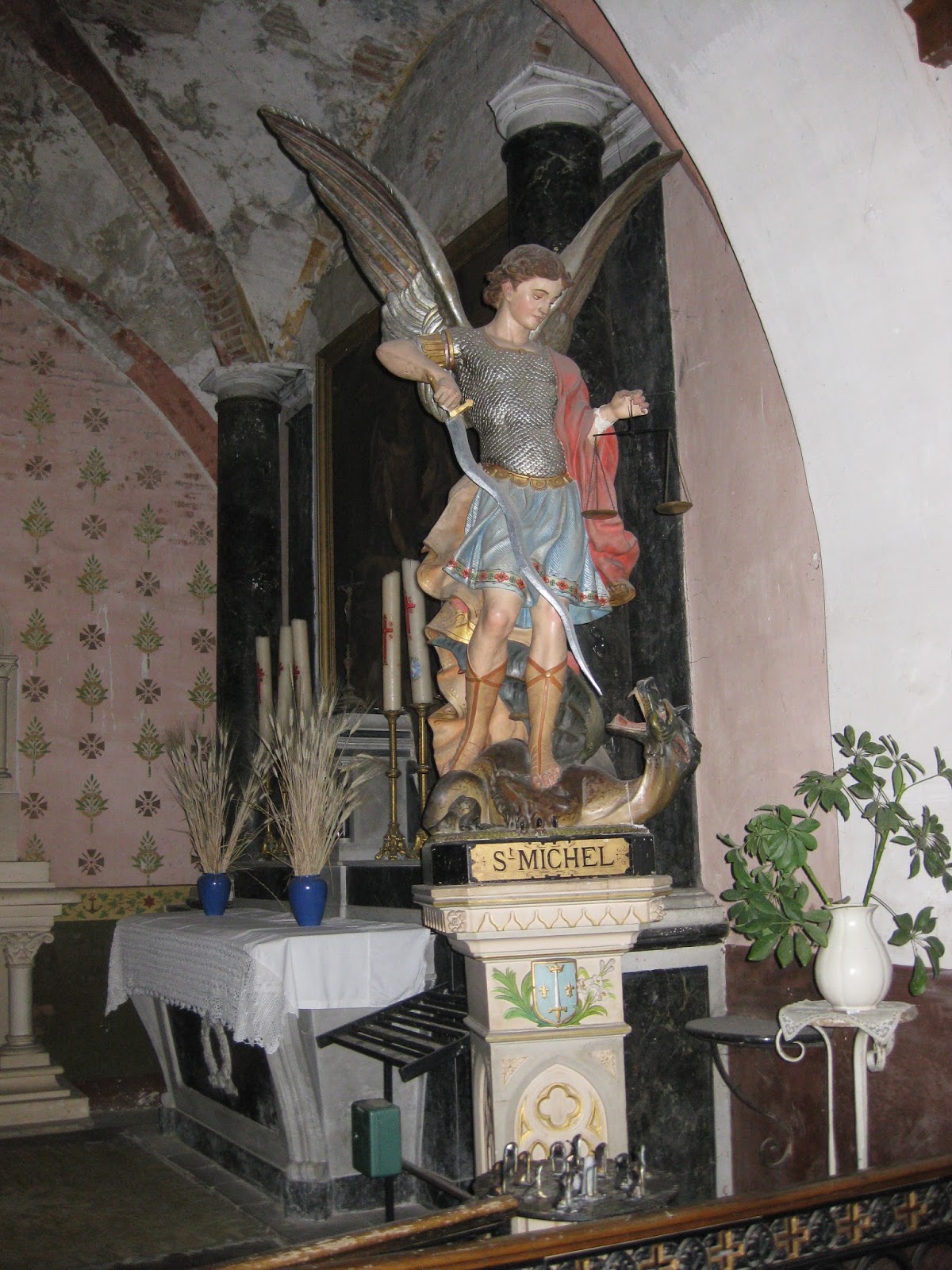
The painted interior is a stunning blue with religious images in the spandrels of ceiling arches. An almost life-sized statue of St. Michael was killing a dragon (I thought it was St. George who killed the dragon).The organ was a 18th baroque century baroque jewel by J.-F. Lepine, restored in the 20th century, is nearly in the same condition as when it was built.
 

Sunday, January 6, 2013

Pipedreams Organ Tour, Day 5b


Pipedreams group, amphitheater at Nimes
 
From Uzès, we drove to Nîmes, once the Roman colony of Nemausus, which boasts some of the best-preserved Roman structures outside of Rome itself, including a huge aqueduct (the spectacular Pont du Gard), a well preserved Roman temple, and a large amphitheater, still used for community events (including bull-fights). We visited the aqueduct first, which was amazingly intact for a two-thousand-year old structure of that size. It crosses the Gard River, and in antiquity, it carried water from Nîmes to Avignon. The aqueduct was a tourist draw, but uncrowded, as were the other Roman structures we visited. I recommend Nîmes as a destination for those interested in ancient Roman artifacts who don’t like to hassle the crowds. The Roman temple, called the “square house” of Nîmes, was built in 02– 05 AD when Augustus was emperor.

Pont du Gard, Nîmes


The two churches (with organs) we visited that day (Friday, May 14) in Nîmes were the Église Saint-Paul and the Cathédrale Notre-Dame & Saint-Castor. Both had classic Cavaille-Coll organs (19th century) which have been recently restored, to good effect.

The organ in the Église Saint-Paul was one of my favorites of the entire trip. The low, vibrating tones resonate through the church and through the body, giving a reassuring sense of grandeur and protection, as if the tones offered the power of a massive, surrounding shield. Even the higher, lighter tones of the organ have a masculine sound.


The Cathédrale Notre-Dame & Saint-Castor was a Romanesque cathedral built in the 11th century, partly destroyed during the religious wars (Reformation), and reconstructed in the 17th century. It was embedded in a conglomerate of buildings in the center of the city, with shops attached to its walls like accretions or parasites on the side of a whale. The church was quite dark inside, and I couldn’t get a good, in-focus picture of the organ. Moreover, the organ seemed to have a rather more tinny sound than some of the others we’ve heard.


Sunday, November 4, 2012

Pipedreams Organ Tour, Day 3


  After a very pleasant dinner , we spent the night in Aix-en-Provence.
The following morning (Wednesday, May 12) we visited another church in Aix, the Eglise Saint-Jean-de-Malte. Unfortunately, I didn’t bring my camera into the church, which was beautiful, with ogival arches and very light inside. On one wall was a painting by Delacroix, which I would love to have photographed. Again, the organ in this church was a new one, simple, with an elegant arrangement of the pipes. Jean-Claude played variations on “Twinkle, Twinkle,” a delightfully irreverent tune that suited the organ’s abilities.

From there, we went to Beaucaire, to the Eglise Notre-Dame des Pommiers, a baroque structure that scarcely looks like a church from the outside. The organ was built in 1849, using an even older case. It was restored between 1986 and ’88 and is considered an “Historical Monument.”
http://www.youtube.com/watch?v=CM0ICStqOok&playnext=1&list=PLC6F133B57E5CAF89&feature=results_video


Notre-Dame des Pommiers, organ pipes.
The next stop (third church of the day) was Roquemaure, the Collegiale Saint-Jean-Baptiste. This is an old church, with an old organ, apparently constructed in the 17th century and transferred to the church in the 19th century. The pipes are very well preserved, and the organ was restored in 1989. The church claims the remains of Saint Valentine (moved there in 1868). I wonder what lovers fought over those remains and where they were originally! The structure of the pipe assembly includes elements of both Spanish and Italian style organs; lovely stained windows illuminate the sanctuary.
Roquemaure, Collegiale Saint-Jean-Baptiste
http://www.youtube.com/watch?v=bRgL5rJb8-8&feature=BFa&list=PLC6F133B57E5CAF89


After Roquemaure, we went to an organ builder’s workshop, Pascal Quoirin, a fascinating behind-the scenes glimpse at the guts of those magnificent music-makers. We saw two disassembled organs: one, being restored, from the cathedral at Toulon, and one being newly constructed for the Church of the Ascension (Episcopal?) in New York. We saw cabinetry, pipes and pipe construction, reeds and shallots. The many different types of pipes – tapered (trumpets), constant diameter, with and without reeds, the kinds of pipes in wood or metal – mostly tin (Sn) with about 10% lead (Pb) and even some (~0.1%) gold (Au). It seems that hammered and unhammered tin have different hardness and different sound.


Organ builder’s workshop, Pascal Quoirin

After the workshop visit, we went into the city of Avignon, where we were to spend the night in a hotel. The rest of the group went  to the cathedral (Notre-Dame des Doms), but I didn’t go; I was tired and wanted to take a shower and go to bed.

Tuesday, October 16, 2012

Pipedreams organ tour, Day 2


On the second day of the Pipedreams tour (Tuesday, May 11), we visited five different churches in five different towns in Provence, all in the vicinity of Marseilles. This seemed like a bit of a forced march to me, as I’m used to taking vacations in a leisurely and exploratory fashion.
Libbie at Notre Dame de l’Assomption

The first town was Barjols, and the church was the Collegiale Notre-Dame de l’Assomption. It was built into a town square, with commercial buildings sharing its walls. The interior was simple, but the organ was ancient, having been built in 1657 and restored in 1837. Several modifications were made in the later 19th and 20th century, but these were “reversed” in 1986, giving the organ its authentic functions and old, rich tone.

Organ at Basilique Sainte-Marie-Madeleine
http://www.youtube.com/watch?v=AoV6UNwvcjc&feature=relmfu

The second town was Saint-Maximin la Sainte-Baume, where we visited the Basilique Sainte-Marie-Madeleine (I’m not fabricating any of these names!). The organ was an Isnard organ, built during the last half of the 18th century, so another very old organ whose original pipes have all been preserved, despite several restorations. This is the legendary site where Mary Magdalene, with her brother, Lazarus, landed on a boat trip from the Holy Land and established a Christian colony. A reliquary contains a skull and shin bone, with the epithet: “Noli me tangere.” The crypt contains sarcophagi purporting to contain the remains of Saints Maximin, Sidonius, and Mary Magdelaine.
Organ, Eglise St-Vincent
http://www.youtube.com/watch?v=oTfL6KLMElc&feature=channel
 
The next town on the itinerary was Roquevaire, and the organ was in the Eglise Saint-Vincent. It is a new organ, built in 1993, re-using some pipes. It boasts a total of 5,000 pipes and operates with electric action. The sound is huge and dramatic, and fills the large church with sound. Bell and percussion sounds chime from the high registers. John Claude played a storm scene on the organ that was almost overpowering.      
 
The next town (the fourth) was Bouc-Bel-Air, where the Eglise Saint-Andre sported a much more simple organ, again a new one, completed in 2006. It is a small organ with a good sound (although tinny in spots).
Organ, Eglise St-Andre
http://www.youtube.com/watch?v=ie9nVVZQoPs&feature=channel
The fifth and final stop for the day was in Aix-en-Provence, at the Cathedral Saint-Sauveur. Several organs have been installed in this cathedral, beginning in the 15th century, with the latest restoration in the early 21st century. Several master organists have had a hand in renovations and restorations, including Jean-Esprit Isnard and Aristide Cavaille-Coll, two famous French organ producers. The interior of the cathedral was very dark; the organist, Chantal de Zeeuw, played a piece by a female student of Cesar Frank. The cathedral itself is built upon the foundations of a temple to Apollo.
 Again, the links to YouTube videos were done by Ian Cook, who took sound and videos of many of the organs and their churches.


Cathedral Saint-Sauveur, Aix-en-Provence, outside and inside, with organ loft and pipes.
http://www.youtube.com/watch?v=7TIVyIymyiM&feature=plcp


Monday, October 1, 2012

Organ Tour, Marseilles, Day 1


Monday, May 10, 2010
The Pipedreams tour began in Marseilles immediately after several members of the group were picked up at the airport. We took a quick bus tour around the noisy, bustling city. The first of the three churches visited that day was the Reformed Church, Eglise St.-Vincent-de-Paul. It displayed two large organ cases, mounted on either side of the transept, as well as a choir organ (1948) in the apse. The main, historical organ (1888) had been out of commission for a while, but has since been restored. It was the first organ I heard, so I had nothing to compare it with, but it had a grand sound. The choir organ was not as rich or versatile.
Eglise St. Vincent-de-Paul
http://www.youtube.com/watch?v=XCChLWiNCuI
One person in the group, Ian Cook, posted video and sound of several of the organs we heard on YouTube, and I have included links to some of these beneath captions. 
After listening to the organs at the first church, we had lunch in a quaint library/lunch room near harbor, which was jammed with boats. The lunch, a nice salade Nicoise, was upscale, but we had an issue trying to get some salad (in a plastic container) to take out to our bus driver.
Abbaye de Saint-Victor
 
After lunch, we mounted the hill overlooking the harbor to the imposing Abbaye de Saint-Victor, a basilica that looks like a fortress and that apparently functioned for centuries to protect the harbor. It looms above the harbor, beside a nearby fortres--a statement in stone and strength. Much of the building was done from the 10th through the 14th centuries.

It is an ancient fortress-abbey. Pope Urban V (in Avignon) had once been abbot there and, as pope, fortified it further. It was also used by the Knights of Malta during and after the Crusades. I didn’t have change in Euros at the time to go down into the crypt, which houses remains of pre-Roman habitation, and I regret not seeing that. Apparently the organ in this abbey is a combination of old and new (1888 – 2009), and the sound didn’t seem quite as rich as that in the previous church, but its resonance in that old stone structure was body-penetrating.

Abbaye organ with prominent trumpets
http://www.youtube.com/watch?v=GL_Kd4tCl5c&feature=relmfu

The third church we visited that day was the Eglise Sainte-Marguerite. It was a modest church with a new organ (2003). The church appeared to be modernized from an older church, with bubble-décor windows and plain, painted walls. The paint was peeling in places though, and revealed evidence of painted (frescoed?) walls beneath.


Eglise Sainte-Marguerite


Jean-Claude Guidarini at the organ


Friday, August 24, 2012

Organ Tour, Part 1 - Marseilles


5/21/10 et seq.

I had essentially NO time during the organ tour to record events and impressions, nor to finish writing about the Italy trip, so I’ll try to do as much of that as possible on this train trip and for the couple of days in London. I will fly out of Heathrow (God willing and the ash-cloud doesn’t return) on Monday morning for Kiev. Hopefully, on that trip, I’ll have more time to write as we ply Russia’s rivers and canals.

I’ll try to reconstruct the extraordinary tour of the south of France (Le Midi) and its marvelous organs from a few tidbits of journal entries, from photographs, and from brief notes scribbled in the booklet for the tour: “Historic Organs of Southern France,” May 9 – 21, 2010, with Michael Barone. American Public Media, Pipedreams. I took lots of photos, and these should help refocus the memory.

Nave of Eglise Saint-Vincent-de-Paul
.

My photo strategy for the organ tour was to take a couple of photos of a church from the outside, then a couple of the nave inside, and then a couple of the organ, or more specifically, the pipes and casing or cabinetry. If there was something of particular interest in the church itself – special décor, ancient baptismal font, striking stained-glass windows – I often took photos of that, too. In some cases, I used a video camera (which “disappeared” in Russia) and recorded video and sound, as well.
Organ loft, Eglise Saint-Vincent-de-Paul
The Pipedreams Organ Tour began in the shadow of the Icelandic ash cloud for many of those on the tour, as had this whole trip for me. A few of the participants couldn’t get air flights from Paris to Marseilles and had to take the train. Others were delayed in London and arrived a day late in Marseilles. I arrived the evening before most of the group in the city of Marseilles - once the ancient Greek port of Massilia, and now the largest city of Provence and the second largest city in France. I met Eddie, one of the trip regulars, that first evening and we met again at breakfast.
Eglise Saint-Vincent-de-Paul, Marseilles, France
It turns out that many of those on the tour (perhaps half of them) are Michael Barone groupies and return year after year to visit organs in various parts of the world (mostly Europe), to listen to them, often to play them, and to enjoy one another’s idiosyncratic company and the chance to share a passion for music in their own individualistic manner. There were 22 members of the group (or 23, counting Lise Schmidt, Michael’s significant other of 32 years), as well as three leaders – Michael Barone, the host of Pipedreams on Minnesota Public Radio (which airs on Sunday afternoons in Charleston); Janet Tollund, who led our tour and usually organizes the Pipedreams tours (through her tour company, Accolades), although she usually doesn’t lead the tour itself; and Jean-Claude Guidarini, an accomplished organist from Toulouse, who was apparently the major musical contact for the tour, who knew most of the titular organists and organ builders, and who was usually the first person to play the organ (sometimes after the titular organist) to show off its possibilities with skilled improvisations.
Ancient fortifications above the harbor
Eventually I came to realize that several of the churches we visited had once been catholic cathedrals, converted to protestant churches. It was not always clear, however, which were which. Initially it seemed that church (eglise) signalled a protestant church, and cathedrale (or abbaye or basilique) indicated a catholic church, although, in retrospect, I’m dubious of these distinctions. The south of France has had a complex and contorted religious history, with the Albigensian heresy at the center of much persecution and bloodshed, in addition to the Catholic schism with Rome during which popes took up residency in Avignon, followed eventually by the protestant reformation, which was bloody in this part of Europe – perhaps even bloodier than elsewhere.